



Three months after bringing in a fractional CMO, your law firm should have more than an audit and a calendar of meetings. You should know where cases come from, what you’re willing to pay for them, and the best ways to bring in more of the right cases.
For me as a fractional law firm CMO, the first 90 days have three major checkpoints. By day 30, the full audit of the firm’s performance, from marketing to intake to revenue operations, is complete. I’ve also agreed with the partners on the DNA of the firm, its mission, and how its marketing should reflect it to attract the work the firm was built to handle. My team has already rolled out the first quick fixes, usually including technical improvements to the website.
By day 60, the first few growth initiatives are running, and partners have approved the long-term growth plan, budget, and vendor decisions. By day 90, they’re reviewing a full report on three months of work, from setting goals to delivering on them. Here’s what I expect to happen at each stage.
Why the first three months tell you everything you need to know about your fractional CMO
My view on the fractional CMO role is simple: it’s not supposed to be advisory-only. I should be expected to hit the ground running and make a real impact from day one. That includes execution, especially while I’m evaluating marketing vendors or building an internal team and there aren’t many hands available to help.
I see so many consultants and advisors expecting this role to be purely strategic. They expect to jump on a few calls, build a few strategy documents, and call it a day. This isn’t right, and it tells you a lot about the person you’re about to hire. When I look closely at a firm, I find small, useful things that can be done immediately to support growth. Even well-run firms have inefficiencies, and some have big ones.

I set the priorities, make the recommendations, and take responsibility for the results. My team handles delivery alongside the firm’s employees and vendors. Where something needs my direct involvement, I get involved. Writing ad copy or briefing a landing page shouldn’t have to wait for a new agency contract.
Each stage below explains what I should have delivered as a fractional CMO, which decisions the partners should have made, what the results should show, and when partners should question whether I’m doing my job right.
The first week: get access, test the experience, start fixing
In the first two or three days, I ask for access to the website, Google Ads, Google Analytics, Search Console, Google Business Profile, call tracking, and the CRM or case management system. I check who owns each account and whether the firm can retain access if a vendor leaves.
Then I check what the marketing analytics tools are actually measuring. An ad dashboard can show dozens of conversions while counting page views or clicks on a phone number. I want to distinguish those actions from submitted inquiries, connected calls, and qualified prospects.
I also test the firm as a prospective client would experience it: submit a web form, call during office hours, and call after hours. Does the form work on a phone? Does someone receive the inquiry? Who answers the call, and what happens next?
Build a better case acquisition system for your law firm.
Tell us about your firm and your goals. We’ll give you our honest take on how to get there.
The first fixes should happen that week. My team can correct a broken form notification, add a missing click-to-call link, or exclude clearly irrelevant searches from a paid campaign while I continue the review. I don’t need to waste partners’ time by asking them to give me feedback on every adjustment I make. I know that partners expect fast execution and a proactive approach.
Partners receive a short weekly update: what shipped, what’s next, and what’s blocked.
A simple test for partners: if your CMO hasn’t asked for account access by the end of week one, they’re already behind.
The first month: complete the marketing audit and put fixes into action
By day 30, partners should be able to see changes on their own website and in their marketing accounts. Depending on what the review uncovers, my team may have:
- Changed what the ad campaigns optimize for, from form fills and calls to signed cases, by feeding signed-case data from the CRM back into Google Ads.
- Moved budget away from keywords that produce inquiries but zero signed cases, and toward the ones with the lowest cost per signed case.
- Split searches for the firm’s own name from all other searches, so reports stop crediting ads for clients who were already looking for the firm.
- Fixed conversion tracking that counted page views, repeat calls, or duplicate form submissions as new leads, and tied every call and form to its source.
- Found practice pages that Google had been told to skip or that competed with each other for the same search, and fixed them.
- Opened the site to AI search crawlers that were blocked, and corrected inconsistent firm details on the directories AI assistants pull from.
- Started follow-up with suitable unsigned leads from the last twelve months, and review requests to recently closed clients.
I don’t hold these changes until the audit presentation. Each goes into a fix log with its date, owner, and effect. Some effects are immediately verifiable, such as a form reaching the right inbox. Others need time and data, such as whether a faster practice page produces more inquiries.
Alongside those fixes, I put the firm’s DNA and mission into a short written statement for the partners to approve. It identifies the cases and matters the firm wants, the work it turns away, the clients it serves best, and how marketing should reflect the identity of the firm. For example, a business law firm focused on ongoing counsel for established companies needs different campaigns and messaging from one seeking one-off incorporation work.
The audit connects those priorities to the firm’s economics. I review vendors, accounts, tools, spending, and six months of available inquiry and signed-case results. I check how a signed matter is recorded, how its fees connect back to a marketing source, and where the handoff from intake to an attorney loses prospective clients. I also check account ownership and arrange a review of inherited campaigns against the applicable state’s lawyer advertising rules.
Gaps in the data need a practical response. If half the signed cases have no source recorded, I have my team add a required source field to the intake workflow, retain an honest “unknown” option, and assign someone to reconcile new signed matters each week. That improves future reporting without pretending the missing history can be recovered.
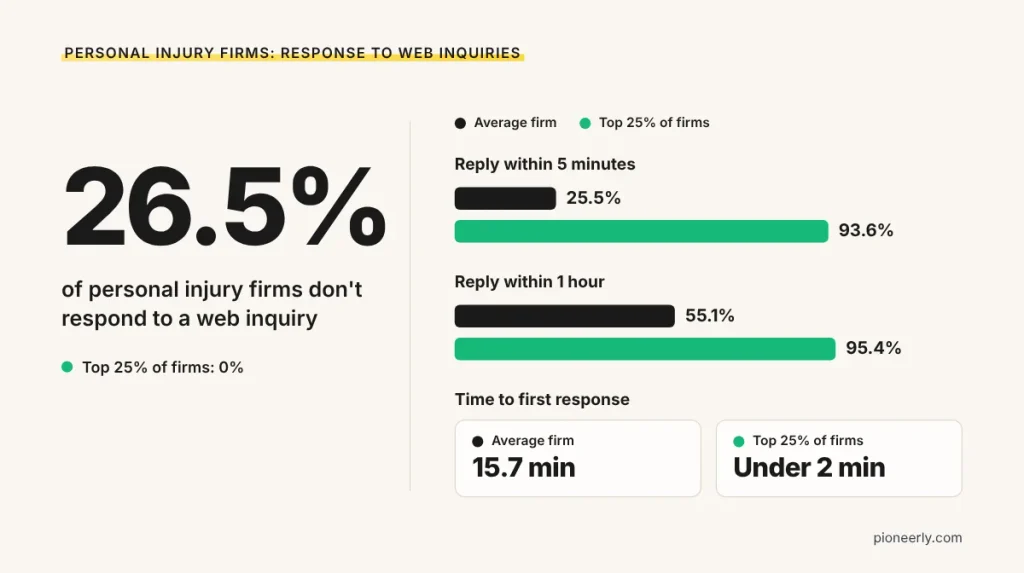
Intake is part of this review because marketing results depend on what happens after an inquiry. Pioneerly’s personal injury marketing benchmarks found that 26.5% of tested firms didn’t respond to web inquiries (sic!).
Before the month ends, I recommend targets for qualified inquiries, consultations, signed cases, and cost per signed case. Partners approve them against the firm’s priorities, margins, and capacity. Where historical tracking is unreliable, I identify what can be compared now and when a dependable baseline will be available.
What partners see: Changes already live, a dated fix log showing their effects, and an agreed direction for the firm’s case mix and marketing. The audit establishes the starting numbers and the targets those changes are intended to support.
The signal it’s working: Partners can inspect the changes themselves. Early measures show whether irrelevant ad spend has fallen, more visitors are submitting inquiries, or fewer inquiries are being lost. I distinguish actual improvement from an increase caused by corrected tracking.
The warning sign about your fractional CMO: Day 30 arrives with a slide deck, but nothing on the website, in the ad account, or in the working process has changed.
The second month: launch growth campaigns and approve the firm’s marketing plan
By day 60, the first growth initiatives should be live. For a firm prioritizing a particular case type, that might mean a rebuilt paid search campaign and a stronger practice page on the website. For another, it could mean a review program and a referral program involving past clients and attorneys in complementary practices.
I choose initiatives that fit the firm’s goals and can be measured. Each needs a launch date, an owner, a budget, and a way to connect the resulting inquiries to consultations and signed matters.
Vendor changes shouldn’t put that work on hold. While I evaluate an agency, I can write the ad copy or brief the page myself, with my team building and launching the approved work. I agree on the interim responsibilities and costs so the firm knows who’s doing what while the permanent arrangement is settled.
The longer-term plan follows from that early work. By day 60, partners should have approved a twelve-month growth plan covering the priority case types, signed-case targets, channel budgets, acceptable acquisition costs, and the additional workload the firm can handle.
Before approving the plan, partners should ask: which initiatives are expected to produce results this quarter, and which are investments for later? Every priority needs someone responsible for delivering it.
The budget should explain the full cost of delivery, including leadership, execution, media, and tools. Before approving it, ask: how many suitable signed cases does this spending need to produce, at what cost per case, and how long will the test run before I recommend a change?
Every vendor also gets a decision: keep, give a clearer brief, or replace. A useful scorecard shows the agreed work, what actually launched, spending, qualified inquiries, signed cases where attributable, and the next action. If the evidence is incomplete, it should say so. A list of meetings and deliverables doesn’t establish performance.
The monthly rhythm stays simple: review results, make the required decisions, and assign the next work. Weekly updates keep partners informed between those reviews.
What partners see: At least two growth initiatives running, with their spending and inquiry results visible, alongside an approved plan, budget, and decision for each vendor.
The signal it’s working: Those initiatives are producing inquiries the firm can count and assess for fit. The report shows how many have reached consultation or signing, rather than treating every inquiry as a success.
The warning sign about your fractional CMO: The plan is approved, the vendors have been discussed, but nothing new is actually happening.
The third month: measure results and evaluate your fractional CMO’s performance
The day-90 report should answer a straightforward question: what is different because of the work completed this quarter?
I put the starting position beside the current results and the targets agreed at day 30. The comparison covers qualified inquiries, consultations booked and held, signed cases, and cost per signed case, separated by channel and priority practice where the data allows.
Day 0 versus day 90 means comparable reporting periods, such as the month before the engagement and the latest complete month. I also show the quarter’s totals and allow for the time prospects take to sign. A campaign launched two weeks ago shouldn’t be judged as though it had been running for three months.
The report includes spending against plan, open opportunities, and signed or estimated fees. Estimated fees stay separate from collected revenue, which may relate to much older matters.
Partners also receive the full record of what shipped: campaigns launched, pages rebuilt, technical fixes completed, review and referral programs started, and changes to follow-up. I include what was tried and stopped, the cost of those tests, and why I stopped them.
Paid campaigns can produce measurable inquiries and signings within 90 days, although the firm’s sales cycle affects what can be concluded. Organic and AI search usually need a longer assessment period. I still account for the work completed and show changes in visibility, qualified inquiries, and early signings against the plan.
The results lead to recommendations. A paid campaign producing suitable cases below the agreed cost ceiling may justify more budget. One producing inquiries but no signings needs investigation and a decision to change, stop, or continue a defined test with a deadline.
Staffing decisions follow the same logic. If the evidence supports hiring a marketing coordinator or adding intake capacity, I explain the responsibility, expected benefit, and cost. Sometimes the right recommendation is to improve the existing process and make no hire.
Day 90 is also the renewal decision. My fractional CMO engagement starts with a three-month term. Partners should now have enough evidence to decide whether to continue: what I delivered, how I handled setbacks, what changed in the numbers, and whether the next quarter’s recommendations deserve further investment.
What partners see: Live campaigns and completed improvements, a clear comparison of starting results against current results and targets, and specific recommendations on spending, staffing, and the next quarter.
The signal it’s working: More suitable cases are being signed, acquisition costs are improving, or the agreed case mix is moving in the right direction. Where a target hasn’t been met, I can explain the gap with evidence and recommend a specific response.
The warning sign about your fractional CMO: The report counts posts, meetings, and documents, but shows no improvement in signed cases or cost per case and gives no credible explanation for why.
What the firm has to provide
I need account access in week one, available case economics and signed-case records during the first two weeks. I also expect the managing partner (or a designated partner) to attend the monthly results review.
The intake lead needs time to help investigate missed opportunities and implement agreed changes. The firm’s employees or intake provider continue handling inquiries; I direct improvements and check their effect.
Incomplete records shouldn’t delay the start. Give me what exists so I can establish what is usable and get the gaps addressed.
Three months with a fractional law firm CMO should feel more productive than the previous two quarters.
Your firm should have growth initiatives running, practical improvements in place, and evidence of what changed in qualified inquiries, signed cases, acquisition costs, and case mix. You should also know which initiatives haven’t worked and what happens next.
The assets stay with the firm: campaigns, pages, reporting, tracking, the written positioning, the growth plan, and the record of completed work. Marketing accounts and vendor contracts should be in the firm’s name.
You should have a decision process that works. I identify the problem, recommend a response, and explain the reasoning. Partners approve or reject the recommendation, someone owns delivery, and the next review checks the result.
After 90 days, you should be able to answer from one page where your cases come from, what each costs, and what you’re doing about it next month.