



A managing partner of a mid-size personal injury law firm based in New York reads two reports in the same week. The marketing agency report says 412 inquiries this month, up 20% on last year. The case management system says 31 new matters, the same as last quarter. Both reports are correct. Together they describe a firm that’s paying more for the same number of cases.
The partner’s first instinct is usually to call the agency. The agency shows the lead report and, by its own measure, it had a good month. The intake team answered more calls than ever. The attorneys held every consultation on the calendar. Everyone involved hit their number, and the firm signed what it signed last year.
This is a real example from a partner who reached out to Pioneerly for help. It’s a problem I’ve seen at many firms, so I decided to break down what causes the gap between leads and signed cases, why it persists, and who’s in a position to close it and how.
Where do law firms lose potential clients between inquiry and signed retainer?
I see law firms losing suitable potential clients at every step after the initial inquiry: the speed and quality of the first response, the qualification process, consultation booking, attendance, and signing. A prospect waits hours for a callback or gets a rushed answer that leaves their questions unresolved. A suitable case is rejected because intake asks the wrong screening questions. A qualified prospect waits days for an available appointment. Someone misses a consultation because they never received a reminder. A person ready to hire the firm leaves the consultation without clear instructions for signing the agreement. To find the problem at your firm, and there’s usually more than one, you need to track what happens at each stage.
Our 2026 Personal Injury Marketing Benchmarks compare these stages with the average and top-quarter results for each metric. Personal injury is the practice we have the deepest data for. Other practices can use the same questions to examine their intake, but their conversion rates and case economics will differ.
| Step | Average firm | Top 25% |
|---|---|---|
| Inquiries that qualify as potential cases | 43.7% | 50.7% |
| Qualified leads that book a consultation | 70.7% | 83.7% |
| Booked consultations attended | 81.4% | 98.6% |
| Consultations that become signed cases | 34.3% | 66.0% |
| All inquiries that become signed clients | 10.6% | 21.7% |
Source: Pioneerly 2026 Personal Injury Marketing Benchmarks.
The final row gives the overall comparison: about 11 signed clients per 100 inquiries at the average rate, versus about 22 at the top-quarter rate. The other rows help identify where to investigate. Each benchmark uses its own sample, so these figures don’t describe one group of firms moving through a single funnel, and the stage rates should not be multiplied together. The response and follow-up figures point to further opportunities:
- 26.5% of firms never respond to a web inquiry. The benchmarks report a 15.7-minute average first response in office hours and a separate 12.8-minute figure among firms that reply at all. The top-quarter benchmark is under two minutes.
- 25.6% of calls go unanswered, compared with under 4.7% in the top quarter.
- 33.7% of inquiries arrive after hours. Separately, the top-quarter benchmark for human coverage is 96.3% of after-hours contacts answered.
- The average firm follows up once or twice. The top-quarter benchmark is nine to fourteen attempts by call, text, and email over 13 to 31 days.
- 34.3% of consultations become signed cases at the average firm, compared with 66.0% in the top quarter.
Before making any assumptions about your marketing funnel or trying to fix it, make sure you’re measuring each of the stages I listed so you can compare your performance with benchmarks. Bear in mind that even if you’re already beating those benchmarks, your firm’s circumstances may still leave plenty of room for improvement. But that comparison is a good place to start.
Some inquiries should be turned away. Your firm may lack capacity (that’s an operational problem you should look into separately), the case may fall outside your focus area or practice, or the matter may not meet your firm’s acceptance criteria. The goal is more of the cases your firm wants, not as many cases as possible. When analyzing your funnel, you need to distinguish appropriate declines from suitable prospects lost through slow responses, missed appointments, or incomplete follow-up.
Why aren’t more law firm leads turning into signed cases?
More leads won’t produce more signed cases if the additional inquiries are unsuitable or your firm can’t convert them. The problem can persist even when each team meets its own targets, because no one is responsible for the result across marketing, intake, and consultations. A common division of responsibilities I see at mid-size firms looks like this:
| Step | Who works it | What they’re measured on | What they can see |
|---|---|---|---|
| Inquiry | Marketing agency | Leads and cost per lead | The ad platforms and the website |
| First contact | Intake team or answering service | Calls answered, speed to answer | The phone system and website forms |
| Qualification | Intake lead or paralegal | Consultations booked | The intake form |
| Consultation | Attorneys | Consultations held | Their calendar |
| Retainer | Office manager | Matters opened | The case management system |
| Overall acquisition results | The managing partner | Revenue reviewed periodically | Reports assembled from separate systems |
Each team can meet a reasonable target while the firm’s signed-case count stays flat. The agency delivers leads. Intake answers calls. Attorneys hold consultations. Those measures are useful, but someone also needs to ask whether the inquiries fit the firm’s criteria, where suitable prospects drop out, and what changes would help them become clients.
The data often follows the same divisions. The agency reports form submissions, the phone system records calls, and the case management system records opened matters. Unless those records are connected, the managing partner can’t reliably trace a signed case back to its source or see what happened to the inquiries that never became matters.
Build a better case acquisition system for your law firm.
Tell us about your firm and your goals. We’ll give you our honest take on how to get there.
AI search adds another reason to look beyond volume. A prospect might ask an assistant which Denver family law firms handle a divorce involving a jointly owned business before contacting a lawyer. Our personal injury benchmarks put the share of leads from AI assistants at 1.5% on average and 3.6% in the top quarter. Separately, Semrush’s AI search study found that AI-referred visitors were 4.4 times as valuable as organic search visitors based on conversion rate. That finding isn’t a law-firm signing-rate benchmark, but it shows why smaller traffic sources deserve to be evaluated on what their visitors do next.
A lead report tells you how many inquiries arrived. To judge growth, you also need to know which inquiries became suitable cases and what the firm spent to acquire them.
Who should be responsible for converting law firm leads into clients?
Responsibility should sit with someone who can see the full path from inquiry to signed case and coordinate changes across the teams involved. This is the role we take on when working with law firms at Pioneerly. As a practice growth firm, we go beyond traditional marketing agency work to address the full acquisition funnel. It’s the only way we can continuously optimize the case acquisition system we build for our clients.
At many firms, that role could be filled by a managing partner or an empowered internal leader. The deciding factors are access to the data, time to act on it, and authority to resolve problems. Here’s how the common options compare.
The intake vendor or answering service. A service that responds promptly, including after hours, addresses a real source of missed opportunities. Some also qualify inquiries, book appointments, and follow up. Its scope still needs to connect with the firm’s marketing and attorneys: answering every call won’t resolve unsuitable leads or delays after a consultation.
The in-house marketing manager. A marketing manager may be well placed to connect agency reports with intake results. The limitation is often authority. If they can’t change intake procedures, obtain consultation outcomes, or get decisions from the attorneys, they can identify problems without being able to resolve them. Give an internal leader the access and mandate the role requires.
Practice management software. Software can connect records, automate reminders, and support follow-up when it’s configured to do so. But a system that only records opened matters won’t explain why earlier inquiries failed to convert. The firm needs prospect records linked to case outcomes, plus someone responsible for using that information to improve the process.
The managing partner. A managing partner can set priorities and require cooperation across marketing, intake, and attorneys. Time is usually the constraint. Alongside a caseload, finances, hiring, and business development, there may be little room to review missed opportunities every week. Without someone managing that work, the firm can remain dependent on the partner’s personal relationships for new business.
A practice growth firm. This is the category we built Pioneerly to serve, so I have a commercial interest in this approach. Our role is to coordinate client acquisition from the first inquiry to the signed case and report on signed cases, cost per signed case, and return on marketing spend. We run the marketing, help the firm’s intake team improve conversion, and connect the data so the partner can see which sources produce cases.
The same standard should apply to us and to anyone else doing the job: can they identify where suitable prospects are being lost, get the necessary changes made, and show whether the results improve? A managing partner or internal leader with the time and authority can do this too. The work below is what matters.
How can a law firm convert more leads into signed cases?
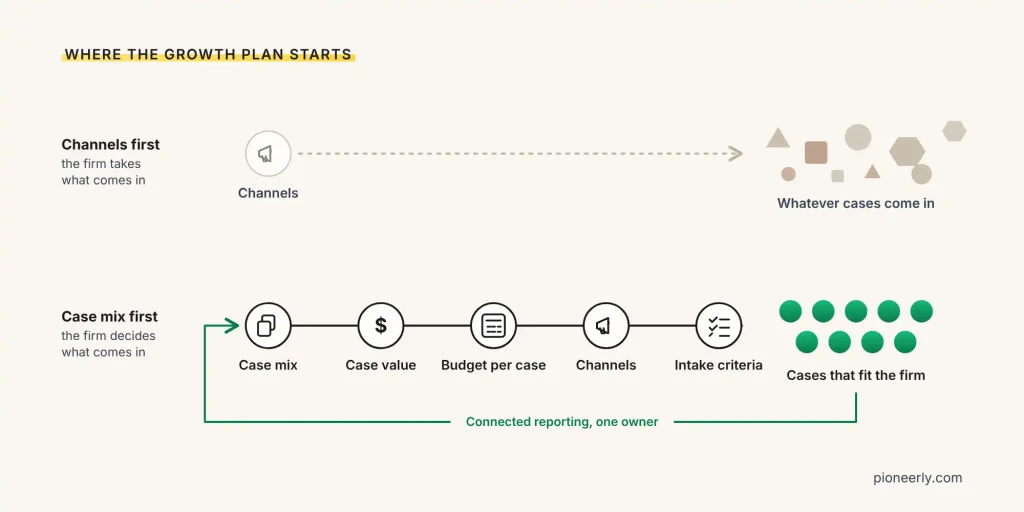
When it comes to law firm growth, I always start with the firm’s mission and case economics. I’ve seen too many law firm owners hire marketing vendors to handle SEO, ads, and other channels, only to find themselves at the mercy of whatever leads come in. Before long, they barely recognize their own firm because they’re doing work they never wanted to do.
Start by defining the case mix your firm wants. Your marketing partner or in-house marketing team should then choose the channels best suited to attracting those cases and building growth momentum within your budget. Then connect your reporting across marketing, intake, and signed cases, fix the points where suitable prospects are lost, and give one person responsibility for following through. These are the seven areas I work through with law firms at Pioneerly.
How much should a law firm spend to acquire a new case?
A firm’s acquisition budget should reflect the expected fees, the cost of handling the matter, the margin it needs to retain, and the pace of growth it wants to achieve. The last factor is just as important as the other three, and it’s worth being honest with yourself here. If you want to grow fast, your actions and risk tolerance must match your goals. Fast-growing firms move quickly, try different things, let the market show them what works and what doesn’t, and then reallocate spending to support the best-performing channels and initiatives. At Pioneerly, we decided to build our own market intelligence to help fast-growing firms reduce some of the risk and trial and error. With real market data, firms can make marketing and spending decisions with less guesswork and spend less time evaluating a channel’s potential.
As I mentioned in the previous chapter, one of the first questions we ask firm owners and managing partners are which matters the firm wants more of. From there, we need to figure out what those matters are worth, and what the firm can afford to pay to sign one. A high-asset divorce, a trucking case, and an uncontested divorce justify different acquisition costs. Those decisions guide which channels to fund, what the advertising says, and which questions intake asks.
Agree on those criteria before increasing the marketing budget. Otherwise, the firm can grow around whichever inquiries the advertising brings in, even when those matters don’t fit its expertise, capacity, or plans.
Which law firm marketing metrics show whether leads are becoming clients?
Track signed cases, the share of inquiries that become signed cases, cost per signed case, and the fees those cases generate relative to marketing spend. Break the results down by source and case type. Cost per signed case is acquisition spending divided by the signed cases attributable to that spending; make clear which costs the report includes. For return on spend, distinguish projected fees from collected fees, especially when cases take months or years to resolve.
At Pioneerly, our reports lead with signed cases, cost per case, and return on spend, and our agreements include a written ROI guarantee. The measures, timeframe, and terms need to be clear. Our personal injury benchmarks report cost per signed case of $2,956 on average and $1,631 in the top quarter. Those are reference points. A firm’s target should also reflect its market, case mix, and economics.
How can law firm marketing attract better-qualified leads?
Your marketing should make it clear which cases your firm handles, whom it can help, what its unique strengths are, and what happens after an inquiry. For example, an ad in Miami can name the case type, explain the fee structure, and describe the first call. A landing page can clarify the firm’s acceptance criteria and when it refers a matter elsewhere. Test whether that clarity leads to more qualified inquiries and signed cases, rather than judging the copy only by clicks. For this article, I won’t go into detail on messaging or differentiation.
The same principle applies to search. A firm’s website, Google Maps listing, and information cited in AI-generated answers help people assess whether the firm fits their needs. Pages should answer practical questions about case types, fees, and the first consultation. That can help prospects arrive better informed, but intake still needs to qualify each inquiry.
How can a law firm improve intake response times and follow-up?
Set clear response targets, assign after-hours coverage, and give every suitable inquiry a follow-up owner. Pioneerly helps set up that process with the firm’s team, its vendor, or both. Where there are gaps after hours or during busy periods, we build an AI agent to answer, qualify, and book consultations, with a handoff to a human when one is available. The firm keeps its intake operation; we provide tools, implementation support, and measurement.
Track time to first response, after-hours coverage, follow-up attempts, and consultations booked per qualified inquiry. Compare the firm’s own results with the relevant benchmark, then review whether the changes produce more attended consultations and signed cases. One personal injury law firm I work with went from an average lead response time of over four hours to under five minutes after its after-hours agent went live. Nothing else about its marketing changed that month. That result measures faster response; the signing rate still needs to be tracked separately.
How can a law firm turn more consultations into signed clients?
Make the decision and next steps clear during the consultation, send the fee agreement promptly when the firm offers representation, and assign follow-up for suitable prospects who haven’t signed. Our benchmarks report 34.3% of consultations converting at the average personal injury firm, compared with 66.0% in the top quarter. They also report 3.2 days from first contact to a signed agreement on average, versus same-day electronic signing in the top quarter. Review appointment availability, the consultation itself, agreement delivery, and follow-up separately to find the delay.
Qualified prospects who haven’t signed are worth revisiting because your firm has already invested in reaching and assessing them. At Pioneerly, we run follow-up campaigns for unsigned leads and stay-in-touch campaigns for past clients, with different purposes. The first helps recover suitable opportunities; the second supports relationships and referrals. Our benchmarks put referrals at 37.4% of signed personal injury cases on average and 55.6% or more at relationship-led firms. Those referral figures support investing in relationships; they don’t measure the success of unsigned-lead follow-up.
What should a law firm client acquisition manager be accountable for?
The person leading client acquisition at your firm should be accountable for the full result: suitable signed cases, acquisition cost, and the changes needed to improve both. That requires access to marketing, intake, and consultation data, plus an agreed way to resolve problems with the managing partner. At Pioneerly, that role is the dedicated Growth Counsel, who leads your marketing, intake-support, and analytics work and works directly with the partner.
I hold that role for several of our clients, alongside Matt. It gives the partner one person to call who knows the firm very well, can explain what is happening, and can coordinate the next action. Without that responsibility, even an accurate marketing report is just another document nobody acts on.
How can AI help law firms improve lead conversion?
AI can support lead conversion by helping teams connect records, respond to inquiries, and identify where follow-up breaks down. At Pioneerly, we use it alongside integrations that bring advertising, call, intake, and case data into one view. An intake agent can respond outside office hours and book a consultation. Our Firm Intelligence audit examines a firm’s records to identify missed opportunities and acquisition costs. Each use depends on accurate records and a clear process for the team to follow.
The managing partner should be able to see whether those tools improve response times, consultation attendance, and suitable signed cases. An automated task is useful when it improves the process that produces those outcomes.
Can a law firm sign more cases without increasing its lead volume?
Yes, if the firm is currently losing suitable prospects it could convert. To illustrate the effect, imagine a personal injury firm in Sacramento receiving 400 inquiries a month. Apply the two overall conversion benchmarks to that same inquiry volume:
At 10.6%, 400 inquiries produce about 42 signed cases. At 21.7%, they produce about 87. This is an illustration of how conversion affects case volume, not a forecast that a particular firm can double its cases. Whether that improvement is achievable depends on lead quality, case selection, capacity, and how well the firm handles inquiries.
| Illustrative result | At the average rate | At the top-quarter rate |
|---|---|---|
| Monthly inquiries | 400 | 400 |
| Inquiries that become signed clients | 10.6% | 21.7% |
| Signed cases a month | about 42 | about 87 |
| Cost per signed case if total acquisition spend is fixed | Baseline | About 51% lower |
Source: Pioneerly 2026 Personal Injury Marketing Benchmarks. Illustration calculated from the separately reported overall conversion rates.
If total acquisition spending stayed fixed, the higher conversion rate in this illustration would reduce cost per signed case by about 51%. Improving intake may require additional staffing, tools, or training, so those costs also belong in the decision. The published $2,956 and $1,631 cost benchmarks come from separate measurements and should not be treated as the costs of these two scenarios.
The question to answer before buying more leads is how many suitable prospects the firm could sign by improving what happens after the inquiry.
How do you calculate your law firm’s lead-to-client conversion rate?
Divide the number of signed clients by the number of unique prospective-client inquiries in the same group, then multiply by 100. Start with inquiries received during a defined 90-day period and follow those inquiries through to their outcomes. Don’t simply divide matters opened this quarter by leads received this quarter: some of those matters may have started with earlier inquiries. Pull three connected sets of records:
- Inquiries by source. Combine form submissions, incoming calls, and other new-business inquiries. Remove duplicate contacts from the same prospect and exclude spam, vendor calls, and existing-client service requests. Include genuine prospective-client inquiries the firm missed or declined, with the reason recorded where known. Keep the definition consistent across channels.
- Consultations held. Match attended consultations to those inquiries. Record qualification, booking, and attendance separately so you can distinguish an unsuitable case from a missed appointment or a prospect who never received a response.
- Signed clients. Match signed engagement agreements to the original inquiries and record the signing date. Use opened matters as a substitute only if the firm opens a matter when the client signs. Otherwise, opened matters and signed clients measure different things. Keep unresolved inquiries visible and allow enough time for them to reach an outcome.
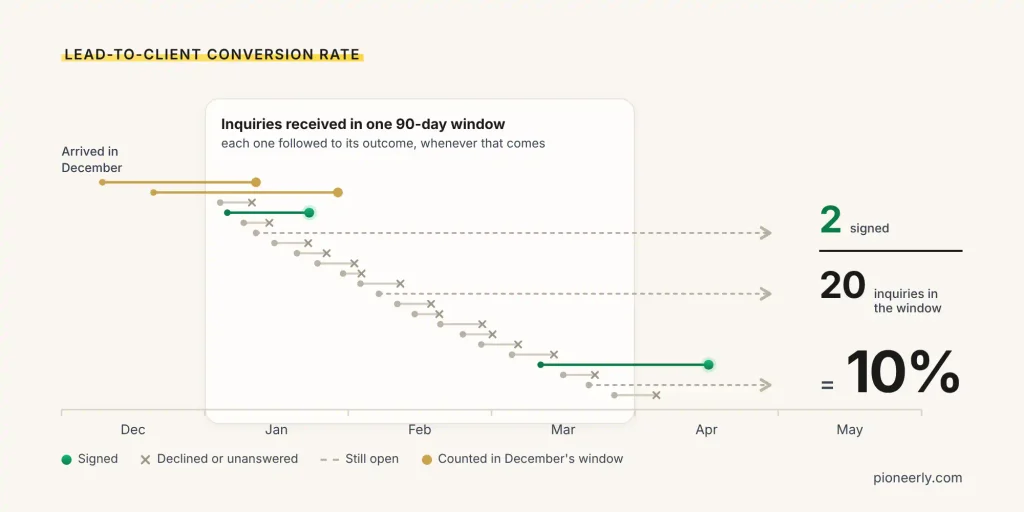
For example, 30 signed clients from 300 unique inquiries is a 10% lead-to-client conversion rate. For a personal injury firm using comparable definitions, that is close to the published 10.6% average. It doesn’t mean half the firm’s inquiries could have become cases. Likewise, a rate near 21.7% doesn’t prove intake has no room to improve. Review the reasons suitable prospects didn’t sign and compare similar case types and sources.
Then compare acquisition cost and case value by source. A source with a higher signing rate may deserve more budget, but only if it produces the cases the firm wants at a workable cost and can continue doing so as spending increases. Unknown sources should remain visible so gaps in the records don’t look like poor channel performance.
This is the first conversation we have with a firm, and it’s where a Growth Counsel starts. If you’d rather work through it together, book a consultation and bring your inquiry, consultation, and signed-client records.
Building accountability into your law firm’s client acquisition process
On the surface, it’s straightforward: more leads turn into more signed cases when the firm attracts suitable prospects and follows through consistently. That takes someone who can connect the records, identify missed opportunities, and coordinate changes across marketing, intake, and attorneys. It requires an operator who understands the entire case acquisition funnel and how the people, processes, and systems behind it drive revenue. That person should be able to show where suitable prospects dropped out, why, what needs to change, and whether those changes are helping the firm sign more of the cases it wants.
A managing partner or an empowered internal leader can take that responsibility, provided they have the time, authority, and expertise to act on it. Firms that need outside support can appoint a practice growth partner. That’s why I built Pioneerly: to take responsibility for the full case acquisition system, from attracting the right prospects to helping the firm sign them. Your firm gets one person accountable for driving the work forward, resolving gaps between teams, and showing what your marketing investment is producing in signed cases.