



Your law firm invests time and money in getting the right potential clients to reach out. Intake determines how much of that investment turns into business. An unanswered call, a delayed follow-up, or a frustrating booking process can cost you a matter before a lawyer ever hears about it. Improving how you handle incoming opportunities can help you sign more of the clients you’re equipped to serve, get more from your marketing budget, and strengthen your bottom line.
AI is opening up new ways to improve that process. AI phone assistants can answer when your team is unavailable, collect basic information, route callers, and, in some cases, book consultations during the same conversation. For firm owners and managing partners, the potential is straightforward: fewer missed opportunities and less administrative work between an initial inquiry and a meaningful conversation with a lawyer.
But introducing AI into intake also means giving software a role in sensitive conversations with prospective clients. Firms need to understand the rules governing that role, including confidentiality, supervision, disclosure, and the boundary between gathering facts and giving legal advice. The requirements depend on where the firm practices, where its callers are located, and what the system is configured to do.
In this guide, I explain how I approach AI-assisted intake, what I advise firm owners to look for, and how I evaluate whether a system helps turn more qualified inquiries into clients while meeting the firm’s professional obligations.
Many law firms are harder to reach than they think
Phone responsiveness remains a weak point for many firms.
For its 2024 Legal Trends Report, Clio commissioned a secret-shopper study in which researchers contacted 500 U.S. law firms with a prospective-client inquiry. Only 40% answered the initial phone call. Even after firms had the opportunity to return the call, 48% were still effectively unreachable by phone. More recently, Pioneerly’s 2026 Personal Injury Marketing Benchmarks showed that up to 25% of calls to personal injury firms go unanswered.
Expectations from potential clients are considerably higher. In Clio’s consumer research, 10% expected a law firm to respond within an hour, 24% within a few hours and another 45% within 24 hours. Taken together, 79% expected a response within a day.
The point isn’t that every person automatically hires the first firm that picks up. It’s that relying on voicemail introduces friction at exactly the moment a prospective client is actively looking for help.
And that moment doesn’t necessarily happen between 9 and 5.
Zeeg analyzed one million meetings booked through its platform between September 2025 and August 2026 and found that 33% were booked outside normal office hours, defined as weekdays from 08:00 to 18:00. One in five bookings was made after 18:00. Yet only 13.5% of the meetings themselves took place outside office hours.
That data covers scheduling across Zeeg customers rather than law firms specifically. But the pattern is clear across industries: people may want to arrange an appointment in the evening without wanting to have that appointment in the evening.
In other words, a firm doesn’t necessarily need attorneys taking consultations at 9 p.m. It may simply need a way for someone calling at 9 p.m. to take the next step.
How an AI voice agent works
An AI phone assistant, also called an AI receptionist or AI voice agent, answers calls and holds a spoken conversation with the caller. Instead of working through a menu such as “press 1 for new clients,” the caller explains what they need in their own words, and the assistant asks follow-up questions.
Behind that conversation, three steps happen in quick succession. Speech recognition turns the caller’s words into text. An AI model interprets that text and decides what to say or do based on the firm’s instructions. Voice synthesis then turns the response into speech. The process repeats as the conversation continues.
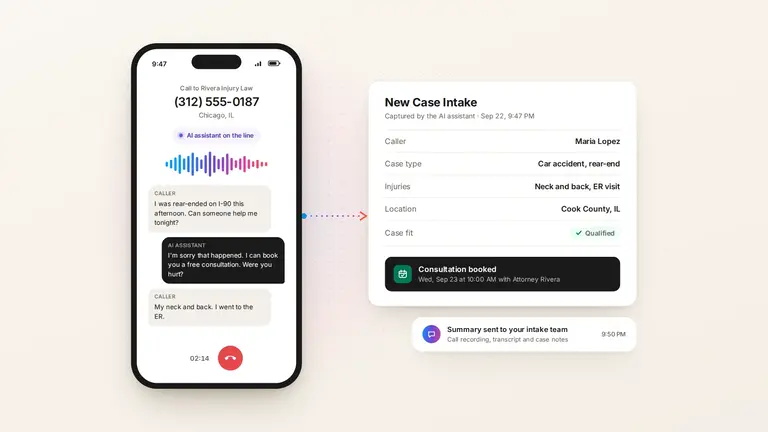
For a law firm, the practical value comes from what the assistant can do with the information it collects. Depending on the product and its setup, it might identify the relevant practice area, ask approved intake questions, transfer the call, check calendar availability, or book a consultation. It may also send your intake team a summary so they can follow up.
This is an important distinction when comparing providers. Some assistants mainly take messages. Others can move a caller through screening and scheduling during the same conversation. To decide which you need, start by looking at where that conversation fits into your intake process.
Where an AI phone agent fits into legal intake
A typical intake process moves from first contact to initial screening, basic information gathering, consultation scheduling, and finally legal evaluation and engagement. AI can support much of the repetitive work in the earlier stages. Deciding whether to take a case, interpreting the law, and giving legal advice still require a lawyer’s professional judgment.
How much of the earlier work you automate depends on the matters you handle. A high-volume personal injury practice with consistent screening questions may have more scope for automation than a specialist firm handling a smaller number of complex inquiries. I recommend starting with the tasks where a prompt, consistent response would help callers and relieve pressure on your team.
There are three common ways to introduce the assistant:
• After-hours coverage handles calls during evenings, weekends, and holidays while leaving your daytime process in place.
• Overflow coverage picks up when your intake team is busy or hasn’t answered within a set period.
• Front-door answering puts the assistant at the start of most incoming calls, with rules for handling routine requests and transferring others.
For a first rollout, after-hours or overflow coverage gives you a manageable way to test the system. You can review how it handles real inquiries and how well your team receives the information before giving it a larger role.
What an AI voice assistant can realistically improve
Once you’ve chosen a role for the assistant, define what success would look like. There’s no single percentage increase in signed cases that every firm should expect. Results depend on your practice area, call volume, current intake process, configuration, and follow-up after the call.
I recommend measuring the specific steps the assistant is meant to improve, then following those inquiries through to consultations and signed clients. That lets you see whether better phone coverage is producing more business or simply more conversations.
Giving after-hours callers a way to move forward
If calls currently go to voicemail after 6 p.m., an AI assistant can give prospective clients a way to explain their needs and take the next step while they’re actively looking for help. As the scheduling data discussed earlier suggests, people may want to arrange an appointment outside office hours even when they’re happy to attend during the working day.
That research covers bookings across Zeeg customers, so it doesn’t tell us how many law firm calls happen after hours or how well AI handles them. Your own call data is what matters here. Track how many after-hours calls concern new matters, how many meet your initial criteria, and how many lead to booked consultations.
Shortening the path from inquiry to consultation
Answering immediately removes the wait for a callback. If the assistant can also check calendar availability and confirm an appointment, it may remove several rounds of scheduling as well. A caller could finish the first conversation knowing when they’ll speak with a lawyer.
Whether that happens consistently depends on the setup. Compare the median time from first inquiry to booked consultation before and after launch. Review calls that don’t lead to a booking to see whether the obstacle is availability, the assistant’s questions, a failed handoff, or something else.
Keeping appointment changes from becoming lost opportunities
Booking the consultation is only part of the process. A caller who never gets through, a prospect who never receives an appointment time, and someone who needs to reschedule have different problems. Your intake process should make each of those situations visible.
In a separate analysis of meetings booked through Zeeg over roughly a year, 48.8% of invitees who could no longer make their appointment rescheduled instead of cancelling. This is general scheduling data, not a measure of law firm intake or AI performance, but it illustrates why changing an appointment should be straightforward. Someone who needs a different time may still want your help.
The same study found that 43% of invitee cancellations happened within 24 hours of the meeting, including 19% with less than three hours’ notice. Track cancellations, reschedules, and no-shows separately so you can identify where follow-up or a simpler booking process might help.
Build a better case acquisition system for your law firm.
Tell us about your firm and your goals. We’ll give you our honest take on how to get there.
Giving the intake team a useful handoff
A voicemail saying “please call me back about my accident” gives your intake team little context. A well-configured assistant can capture contact details, the broad type of matter, relevant dates, location, urgency, and answers to approved screening questions. The person following up can then continue the conversation without asking the caller to start again.
Check how often staff need to repeat questions the assistant was supposed to cover. You can also compare the length and outcomes of follow-up calls before and after implementation. These checks help establish whether the assistant is reducing work or passing incomplete information to the next person.
Finding the biggest opportunity in your intake process
These improvements won’t have equal value for every firm. Before comparing vendors, trace what happens to your incoming inquiries. Start with new-matter calls, then look at how many are answered, how many concern matters you might handle, how many lead to booked and attended consultations, and how many become clients.
Look for the point where suitable prospects stop moving forward. If they’re unable to reach you, better coverage may help. If almost every call is answered but qualified prospects don’t book or hire the firm, you’ll need to understand why. Adding an AI receptionist won’t necessarily resolve a problem with the consultation, follow-up, or fit between the caller’s needs and your services.
This is also how I recommend assessing the financial case. More answered calls matter when they lead to suitable matters and justify the cost of the system and the work around it. Track signed clients alongside software costs and staff time, and distinguish expected fees from revenue you’ve actually collected. That gives you a clearer basis for deciding whether the investment is helping your bottom line.
What to look for when choosing an AI phone assistant for a law firm
Once you know where intake is falling short, you can assess providers against a specific need. A firm struggling with after-hours booking will need different capabilities from one that mainly needs reliable message taking and urgent-call transfers. Use your own scenarios to guide the demo.
Booking and routing
If scheduling is the priority, ask the vendor to demonstrate a complete booking during a call. The assistant should be able to check real availability, offer an appropriate appointment, and confirm it while the caller is still on the line. Check whether bookings can follow your rules for practice area, attorney, office, and language.
An assistant that takes a message may still be useful, but your team will need to finish the process. Be clear about where the automated work ends and who handles the next step.
Control over the conversation
Your firm should be able to define the questions the assistant asks, the information it collects, and the subjects it must refer to a person. Test those controls with situations your team actually encounters. Ask whether you have a strong case, mention a court date tomorrow, or request an estimate of case value.
Watch whether the assistant follows its instructions when pressed for an answer. You should also be able to use different intake questions for different types of matters, rather than forcing every caller through the same script.
Transfers to a person
Some calls will need human attention, so ask the vendor to show how a transfer works from beginning to end. Does the intended recipient receive the information collected so far? What happens if that person doesn’t answer? How does the caller know what will happen next?
Agree on escalation rules before launch, including which situations need immediate attention and who is responsible for taking over. A transfer feature is only useful if someone on your team can receive the call or act on the follow-up.
Information your intake team can use
Ask to see the record left by a test call. A transcript can be helpful, but staff also need to find the key facts quickly, see whether an appointment was booked, and know whether any action is outstanding. Check how that information reaches your existing systems and who receives notifications.
Have the people who will use these records review them during the trial. They’ll be able to tell you whether the summary supports their work or leaves them searching through a conversation for basic details.
Caller data and vendor practices
The information that makes a handoff useful also needs protection. ABA Formal Opinion 512, published in July 2024, addresses lawyers’ existing duties when using generative AI, including competence, confidentiality, communication, and supervision. As a state-specific example, Florida Bar Ethics Opinion 24-1 advises lawyers to investigate vendors’ data retention, sharing, and self-learning policies.
Ask where recordings and transcripts are stored, how long they’re kept, who can access them, and which other providers process the data. Find out whether information can be used for model training, what you can delete, and what happens to stored data when the contract ends. Get the answers in writing so the people reviewing the firm’s obligations can assess the actual service terms.
Performance in real conversations
A polished demonstration won’t show you how the assistant handles every caller. Test it yourself with interruptions, background noise, unusual names, incomplete answers, and changes of mind. If your firm serves callers in other languages, include those conversations too.
Pay attention to how the assistant recovers when it misunderstands something. Can the caller correct a name or phone number easily? Does it recognize when it should stop asking questions and bring in a person? These details can matter as much as how natural the voice sounds.
The full cost of the service
Finally, compare pricing against your expected use. Providers may charge by the minute, by the call, through monthly packages, or through a combination of allowances and usage fees. Estimate your call volume and typical call length before deciding which plan looks economical.
Check for extra charges for transfers, additional phone numbers, simultaneous calls, transcripts, integrations, and usage above the plan allowance. Include any setup and ongoing review work in your assessment so you’re comparing the cost of running the service, not just the advertised subscription.
Setting up the AI assistant for a smooth rollout
Choosing a suitable provider gives you the tools, but the workflow still needs careful design. Start with a short intake conversation that gathers enough information for screening and the next step. A distressed caller shouldn’t have to work through the equivalent of a full consultation just to book one.
Give the assistant clear limits. It can collect facts, explain approved administrative processes, and follow your routing rules. Questions about legal options, case strength, or likely outcomes should go to a lawyer. Make sure the transfer instructions cover both who should receive the call and what happens if that person is unavailable.
Before launch, have several people at the firm test the full process with difficult questions and incomplete information. Follow each test through to the calendar entry, call record, and staff notification. This helps reveal gaps that a successful conversation alone won’t show.
Your intake team also needs to know what the assistant collects, where to find it, and who’s responsible for follow-up. After launch, review a sample of conversations to identify confusing questions, missed details, and situations the original setup didn’t anticipate. Use those findings to refine the instructions and decide whether the system is ready for a broader role.
Keeping AI intake within ethics and confidentiality rules
The controls above also support the firm’s professional obligations. This section provides general information, not legal advice. Requirements vary by jurisdiction, so review the rules that apply to your firm and callers before launch. ABA opinions and Model Rules provide a framework for that review; state rules and guidance determine how it applies in practice.
Telling callers they are speaking with AI
A clear opening greeting can tell callers they’re speaking with the firm’s AI assistant and explain what it can help them do. Review the disclosure requirements that apply to your use of the system rather than assuming every jurisdiction takes the same approach.
For example, Florida Bar Opinion 24-1 says generative AI chatbots communicating with clients or third parties must identify themselves as AI rather than a lawyer or firm employee. That opinion is advisory and specific to Florida. Firms elsewhere should check their own applicable requirements.
Keeping legal judgment with lawyers
The assistant’s instructions should draw a clear line between gathering information and advising the caller. It can ask what happened, collect contact details, and schedule a consultation. It shouldn’t assess whether someone has a winning case, predict an outcome, or recommend a legal strategy.
Florida’s opinion illustrates this distinction by drawing on guidance for nonlawyer intake staff: factual information can be collected during an initial interview, while legal questions should go to a lawyer. It also cautions against assigning AI tasks that require professional judgment. Build that boundary into the conversation and the escalation process.
Supervising the system
ABA Model Rule 5.3 addresses lawyers’ responsibilities for ensuring that nonlawyer assistance is compatible with their professional obligations. Its commentary also covers outside service providers and the protection of client information. Florida Opinion 24-1 applies a similar supervision principle to generative AI and emphasizes that lawyers remain responsible for their professional judgment.
In practice, assign responsibility for approving the assistant’s instructions and reviewing how it performs. Revisit those instructions when your services, intake criteria, or vendor features change. The initial setup is the beginning of supervision, not the end.
Controlling statements about the firm
The assistant also needs limits on what it says about your services. ABA Model Rule 7.1 prohibits false or misleading communications about a lawyer or the lawyer’s services. Review the assistant’s statements with the same care you’d apply to your website or advertising.
Provide approved information about fees, experience, services, and other routine questions. Test whether the assistant stays within that information when a caller asks about specialization, past results, or what the firm can achieve for them.
Limiting what prospective clients disclose
Intake questions deserve the same care as the assistant’s answers. ABA Model Rule 1.18 protects certain information learned from prospective clients even when no engagement follows. Its commentary advises limiting an initial consultation to the information reasonably needed to decide whether to take the matter, in part to avoid receiving unnecessary disqualifying information.
Design the first conversation around the information your firm needs for the next step. Leave detailed discussion for the appropriate stage of your conflict-check and consultation process instead of encouraging callers to share everything with the assistant.
Protecting the information collected
Once the assistant receives information, your firm needs to understand what happens to it. The confidentiality concerns discussed in ABA Formal Opinion 512 and Florida Opinion 24-1 make vendor review part of implementing the service, not simply a technical purchasing decision.
Use the vendor’s written answers about storage, access, retention, and training to assess whether the service fits your obligations. Check the actual settings before launch and make sure they reflect the decisions your firm has made.
Reviewing recording and transcription requirements
AI phone assistants commonly transcribe calls and may also record them. Recording and consent requirements vary across U.S. jurisdictions and can depend on the circumstances of the call. Review which requirements apply to your callers, then configure the relevant notices, consent steps, and storage settings.
Treat disclosure that the caller is speaking with AI and consent to recording as separate questions during that review. A greeting identifying the assistant doesn’t by itself establish that every recording requirement has been addressed.
Reviewing outbound calls separately
An assistant used to answer incoming inquiries may also offer outbound calling, but that function needs its own review. In February 2024, the Federal Communications Commission ruled that AI-generated human voices fall within the TCPA’s restrictions on calls using an “artificial or prerecorded voice.”
Before enabling automated outbound calls, review the TCPA, relevant consent requirements, and applicable professional-conduct rules for the specific calls you plan to make. Approval of an inbound intake workflow shouldn’t be treated as approval of every calling feature the vendor offers.
An example from our work at Zeeg
I work at Zeeg, where we build AI phone assistants and appointment scheduling software. To make the ideas in this article more concrete, I’ll use our own product as an example of how this can work for a law firm.
Imagine a prospective client calls your firm after hours to ask about a personal injury matter. With Zeeg’s AI phone assistant for law firms, you can configure the assistant to collect their contact details, ask your approved screening questions, and, if their answers meet your booking criteria, schedule a consultation in a connected Google, Outlook, or Apple calendar. Your intake team can then review the call notes and transcript before following up.
Your firm decides which inquiries the assistant handles and when it should pass a caller to a person. In that example, the assistant’s job is to help someone move from an initial inquiry to a conversation with your team. Assessing the merits of their case and giving legal advice remain the lawyer’s responsibility.
We also offer controls over whether transcripts, personal data, and recordings are stored, and our assistant identifies itself as AI to callers. We describe Zeeg as GDPR-compliant, but I’d still encourage any U.S. firm considering our product to review its configuration and terms against the rules that apply to its practice. The same questions I’ve outlined for evaluating other providers should apply to us: how will the system handle your callers, protect their information, and help your team turn suitable inquiries into clients?
What to confirm before choosing a provider
By this stage, you should be able to connect the service you’re considering to a specific intake problem. Before committing, make sure your team can answer these questions:
• How many calls do we miss, and when do we miss them?
• Which inquiries should the assistant handle, and which need a person?
• Can it book appropriate consultations into real calendar availability?
• What information will staff receive, and who will act on it?
• Where will caller data be stored, who can access it, and can it be used for training?
• Which disclosure, recording, and professional-conduct requirements apply?
• Who will review performance, and what results would justify keeping or expanding the service?
If you don’t know your current intake numbers, establish a baseline before launch. Otherwise, it will be hard to tell whether the assistant has improved the process or simply changed how calls are handled.
Making the AI investment worthwhile for your firm
An AI phone assistant can help more prospective clients reach your firm and take the next step. Its value depends on where your process currently breaks down. That might mean answering after-hours inquiries, covering busy periods, or making it easier to book the right lawyer without repeated calls and emails.
I recommend starting with one clear use case, keeping legal judgment with lawyers, and reviewing what happens after each inquiry. Follow the results through to attended consultations, signed clients, and the costs of running the service. That’s how you determine whether the assistant is helping your firm make more of the opportunities it’s already earning.