



AI Mode SEO for lawyers starts with a simple requirement: Google must be able to find, index, understand, and trust the pages that prove your law firm is relevant to a specific legal need in a specific market. There’s no separate AI Mode submission, special schema, or llms.txt file that gets a law firm included. A page just needs to be indexed and eligible to appear in Google Search with a snippet. From there, Google may pull it in while answering the user’s original question, or one of the related searches it generates on its own through query fan-out.
In practice, when I work on a client’s visibility in Google’s AI Mode, I focus on five things. First, I make sure there’s no ambiguity about what the firm does and where. Then I build strong pages for the case types the firm actually wants. I add first-hand legal insight that only a skilled attorney could produce. I strengthen the evidence Google can use to verify the firm, its attorneys, its results, and its local presence. And finally, I measure whether all that visibility leads to consultations and signed cases, not whether a tracking tool says the firm was “mentioned.”
For a law firm, good AI Mode SEO usually comes down to:
- technically sound, indexable pages that already deserve to compete in ordinary Google Search.
- focused practice-area and location coverage built around real client situations.
- clear attorney authorship, credentials, review dates, citations to primary legal sources, and careful jurisdictional limits.
- a complete and accurate Google Business Profile, consistent business information, genuine reviews, and corroborating profiles on reputable legal and local sources.
- original material such as attorney explanations, local procedural knowledge, case patterns, data, decision frameworks, checklists, images, and videos.
- internal links that connect broad practice areas to specific issues, locations, attorneys, and useful supporting resources.
- direct answers that can stand on their own, followed by the nuance, exceptions, and next steps a prospective client needs.
- ongoing testing across realistic prompts and follow-up questions, with performance tied back to leads, consultations, hires, and case economics.
The rest of this guide walks through what Google AI Mode actually is, how it picks its sources, what I optimize on a law firm’s website (and what I ignore), and how I judge whether the work is actually producing cases.
What is Google AI Mode?
Google AI Mode is a conversational, Gemini-powered search experience that writes an AI-generated answer and backs it up with links from the web. It began as a U.S. Search Labs experiment on March 5, 2025, and started rolling out to everyone in the United States on May 20, 2025. Google expanded it to more than 180 additional countries and territories in English in August 2025. As of August 2026, Google’s current availability page lists most countries and a broad range of languages, but access to individual models and experimental features still varies by account, subscription, language, and market. Most people in the industry agree this is where search is heading, and we should expect more and more searches to be handled this way.
People can open AI Mode from its own tab in Google Search, go directly to google.com/ai, or use it in the Google app. They can ask with text or voice, upload images through Lens, attach files, and continue with follow-up questions. And if Google isn’t confident enough in the quality or usefulness of an AI answer, it says AI Mode may simply show a set of ordinary web links instead.
For legal searches, AI Mode changes the shape of the client journey. Someone may begin with “What should I do after a delivery driver hit my car in Atlanta and the insurer says I was partly at fault?” From there, the next questions might be about Georgia’s comparative-fault rule, whether the employer can be held liable, what evidence matters, how long a claim takes, and which local attorneys handle commercial-vehicle cases. AI Mode can walk through that whole sequence in a single conversation.
The key thing to understand as a law firm owner is that AI Mode is still part of Google Search. Google says its generative search features are rooted in the Search index, core ranking systems, retrieval-augmented generation, and query fan-out. The interface is new, but the work behind it is still SEO.
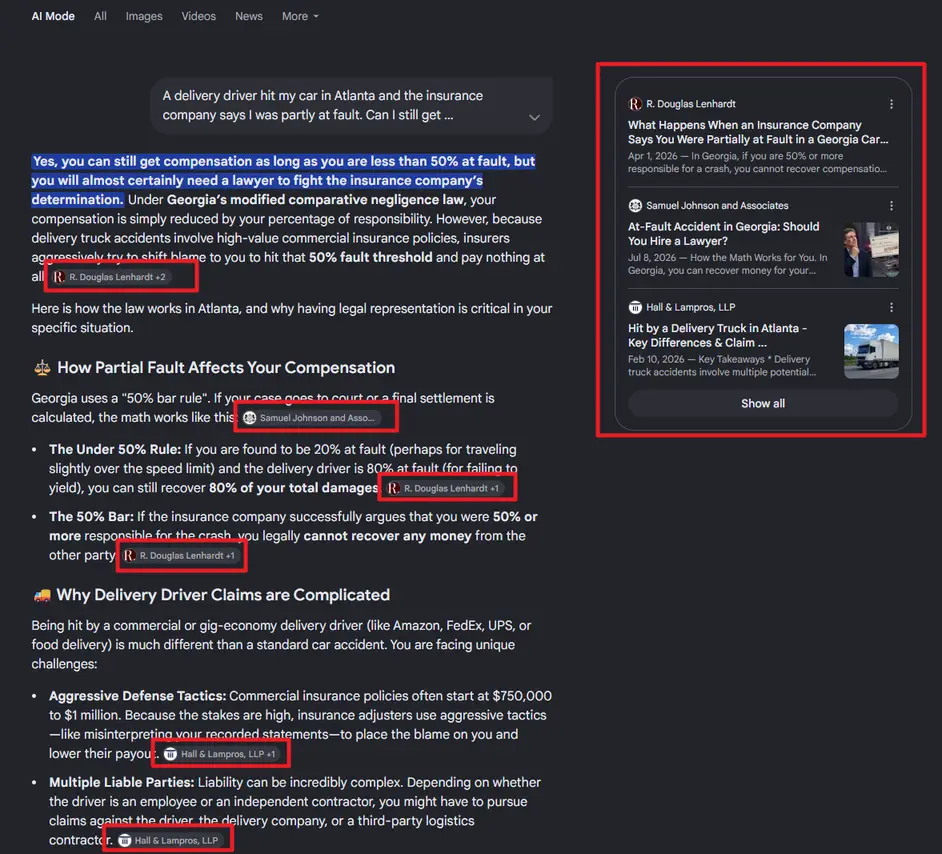
Beyond answers: what else AI Mode can already do
Google has already introduced or tested several other capabilities inside AI Mode. Deep Search can run hundreds of searches and assemble a cited research report. Search Live supports real-time voice and camera conversations. Agentic capabilities can search availability and help users complete tasks such as reservations and local appointments. Personal Intelligence can tailor answers using previous searches and, when a user chooses to connect them, context from Google apps such as Gmail, Calendar, and Photos.
Not all of these are available to every user yet, and I wouldn’t tell a law firm that Google can already book legal consultations automatically in every market. But the direction is clear, and it matters. A potential client can ask for a deep comparison of medical malpractice firms in Baltimore, use follow-ups to narrow the list, and get closer to actually taking action without starting the search over. As Search moves from answering questions toward helping people complete tasks, things like accurate appointment links, clear consultation options, responsive intake, and verifiable information start to matter a lot more.
I don’t think of AI Mode as a replacement for organic search, Google Maps, or a law firm’s website. To me, it’s another presentation layer sitting on top of Google’s search and entity systems. Firms with clear, useful, well-corroborated information simply give Google more material to retrieve, summarize, and cite.
What is the difference between Google Search, AI Overviews, and AI Mode?
| Search experience | When and where it appears | How people interact | What it means for a law firm |
| Classic Google Search | The standard results page for a query, with links, local results, ads, images, videos, and other features | Search, choose a result, and run another search when the question changes | Blue-link, local-pack, and Business Profile visibility still matter |
| AI Overviews | An AI-generated summary within some standard results pages, shown when Google decides it adds value | Read the summary, open a cited source, continue in ordinary results, or move into AI Mode | A firm can lose clicks to the summary or gain prominence as a cited source |
| Google AI Mode | A separate conversational Search experience the user chooses to open | Ask detailed questions, refine them through follow-ups, and use text, voice, images, or files | The firm can enter at different stages, but visibility depends on the subtopics, evidence, and sources Google retrieves |
What does Google AI Mode mean for law firm website traffic?
AI-generated answers can reduce clicks for an obvious reason: people get more of what they need before they ever visit a website. The strongest public click studies we have right now look at AI Overviews rather than AI Mode, so I treat them as directional evidence, not as a forecast for every legal search.
Ahrefs compared 300,000 keywords in March 2025 and found that an AI Overview correlated with a 34.5% lower average click-through rate for the top-ranking informational result. In an updated analysis using December 2025 data, Ahrefs estimated the reduction at 58%. Pew Research Center observed a similar behavioral pattern from a different dataset: users clicked a traditional result on 8% of visits where an AI summary appeared, compared with 15% when one didn’t. They clicked a source inside the summary on only 1% of visits.
Those figures don’t prove AI Mode will cut law firm clicks by the same amount. Legal searches are different: there’s more urgency, more local intent, and a real need for professional help. Google also says the clicks that do come through from pages with AI Overviews tend to be higher quality, although it hasn’t published any law-firm-specific conversion data to back that up.
The practical takeaway is more useful than any universal traffic-loss number: law firms should expect fewer clicks from some informational searches, but the people who do click may arrive further along in their decision and with more context. That makes consultation rate, signed-case rate, case profile, and revenue matter more than traffic alone.
AI Mode visibility is also concentrated. Only a handful of sources get real prominence in the initial answer, and the rest may take another click or two to find. I wouldn’t call visibility strictly binary, because interfaces change and additional links can appear. Commercially, though, being a buried source is nowhere near the same as being one of the first firms or pages the user sees.
How does Google AI Mode work for legal searches?
AI Mode doesn’t run one search and summarize the first result. Instead, it uses a technique called query fan-out: it breaks a question into subtopics, runs several related searches across the data sources it has, pulls in supporting material, and combines what it finds into a single response.
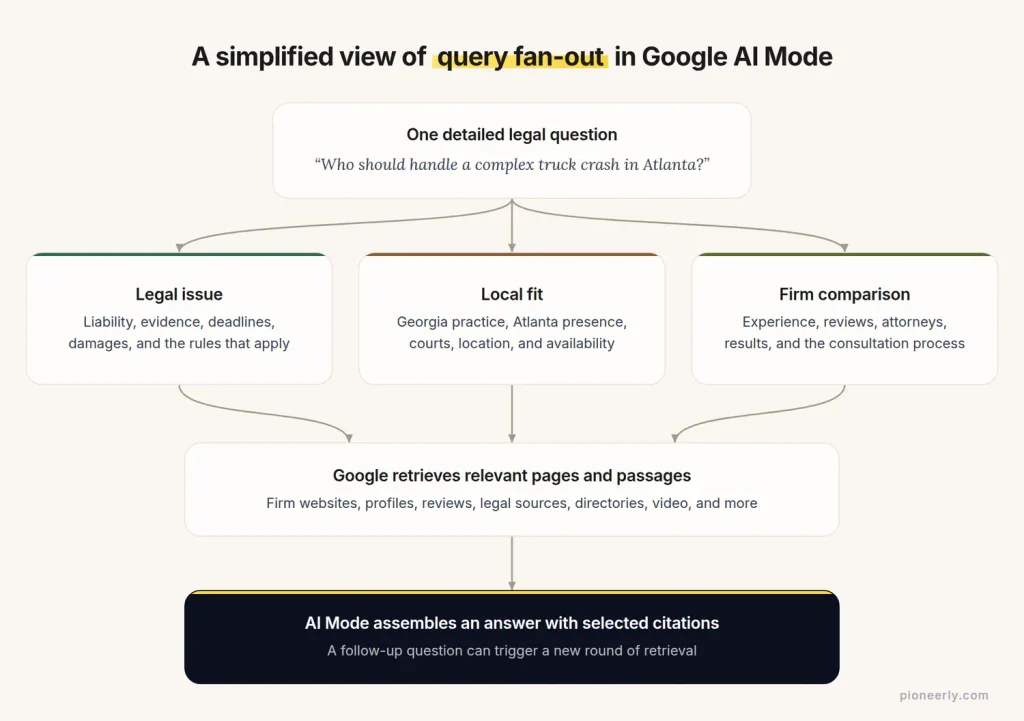
Say someone asks, “Who is a good divorce lawyer near Naperville for a business owner whose spouse may be hiding income?” Behind the scenes, the fan-out might explore things like:
- divorce lawyers near Naperville who handle high-asset cases.
- Illinois treatment of business interests in divorce.
- discovery of hidden income or assets.
- forensic accountants in complex divorces.
- reviews, credentials, locations, and service areas of relevant firms.
- questions the user should ask during a consultation.
Google doesn’t publish the exact fan-out queries behind any individual response, so no keyword tool can show you the complete chain. What I do instead is build a query map, starting from the original client need, then adding the factual modifiers that change the answer, the decision the person is trying to make, and the follow-up questions that naturally come next.
I used this approach when planning content for an immigration practice in South Florida. A page built around “Miami immigration lawyer” was enough to establish the broad service. It couldn’t do much for searches about a marriage-based adjustment after an overstay, a notice of intent to deny, a detained family member, or an employer considering an intracompany transfer. So we organized the information around distinct legal situations and linked each one to the relevant service, attorney, and location. The point wasn’t to manufacture a page for every possible prompt. It was to give Google and prospective clients a coherent body of answers, each with clear jurisdiction, facts, and next steps.
AI Mode also supports follow-ups, and each follow-up can trigger a fresh round of retrieval. That means a firm can enter the conversation after the first answer. Someone might start with a general explanation from a state court or bar association, then ask for a local lawyer with a particular kind of experience. Being visible for education and being visible when someone picks a firm are related, but they’re not the same job.
Build a better case acquisition system for your law firm.
Tell us about your firm and your goals. We’ll give you our honest take on how to get there.
How does AI Mode pick what to cite?
The most useful way to think about it is that sections of pages compete for different parts of an answer. Google officially confirms query fan-out and the use of its Search index and ranking systems, but it doesn’t publish any AI Mode citation formula. Independent analysis of Google’s patents and observed results, including work by iPullRank, suggests the system retrieves relevant passages for each subquery it generates, then cites the passages that support individual parts of the final response.
That distinction explains something lawyers often find confusing. A page can rank eighth for the original wording yet contain the best answer to one hidden subquery, such as preserving delivery-truck data after a Georgia collision. That section can get cited even though the page is nowhere near the first blue link for “Atlanta truck accident lawyer.” And the reverse is true too: ranking first for the broad phrase doesn’t guarantee you a spot in the generated answer.
The often-repeated “25% chance” figure needs some context. iPullRank cites ZipTie data indicating that ranking first for a core query corresponded with roughly a 25% chance of inclusion in an AI Overview. That’s independent data about AI Overviews, not a confirmed AI Mode probability or an official Google benchmark. I’d only use it to illustrate one point: first place and an AI citation are not the same result.
None of this means every paragraph on every page should be reduced to a robotic answer block. It means each important section should do a complete job on its own. What I want in each one is a clear question or topic, a direct answer, the conditions that change it, the jurisdictional context, supporting evidence, and a useful next step. A strong section should still make sense when Google pulls it out without the page’s introduction.
How does AI Mode personalization affect law firm results?
Two people can ask the same question and get different answers or different sources. Google says AI Mode can draw on prior searches and activity when personalization is turned on, and its Personal Intelligence features can also use connected Google apps when the user explicitly allows it. Location still matters for local legal searches, and the earlier questions in a conversation shape what gets retrieved later.
I wouldn’t stretch that into the claim that one earlier visit automatically leads to a later citation, because nothing supports that. What you can safely say is that there’s no single, universal AI Mode ranking to check. Someone who previously searched for the firm, looked at its Business Profile, read an article, or ran into it around town may get a different context than someone who has never seen the name.
That’s why I test with several realistic scenarios and treat branded search, direct visits, Maps activity, community presence, and repeat exposure as parts of one acquisition system. Manual checks from a single Google account are observations, not an objective rank report.
What is AI Mode SEO for lawyers?
AI Mode SEO for lawyers is the process of making a law firm eligible, relevant, verifiable, and useful enough to be found, cited, or recommended when Google builds AI Mode answers. It combines ordinary SEO fundamentals with topic coverage, passage-level usefulness, local accuracy, authority, and measurement tied to signed cases.
What you’re usually after is one or more of these outcomes:
- the firm’s page is cited as a supporting source.
- the firm or an attorney is included when the response discusses relevant providers.
- the firm’s information helps Google answer a local or practice-specific question accurately.
- a user clicks through, calls, submits an inquiry, or later searches for the firm by name.
- the firm remains visible as the conversation becomes more specific.
I use the term AI Mode SEO because that’s what lawyers search for, but I don’t treat it as something separate from SEO. Google itself says that, from its perspective, optimizing for generative Search is still SEO. A technically weak site with thin practice pages, unclear locations, and no real authority doesn’t suddenly become competitive because someone added “GEO” to the marketing plan.
Where the distinction is useful is in how you work day to day. Traditional reporting tends to focus on rankings for a fixed list of short keywords. AI Mode calls for a wider view: topics, supporting evidence, entities, long questions, follow-ups, and citations. It also makes some old reporting habits less useful. A firm can get valuable exposure without “ranking number three” for a single tracked phrase, and it can hold a blue-link position while being completely absent from the generated answer.
Is AI Mode SEO different from traditional law firm SEO?
The foundation is the same, but the way people search in AI Mode shifts the optimization priorities.
Traditional law firm SEO usually asks, “Which page should rank for this query?” AI Mode work adds a second question: “What evidence would Google need to answer this person’s whole situation, and where can it find that evidence?” That pushes you toward broader topical planning, more precise entity information, stronger first-hand material, and content that handles comparisons and exceptions well.
Take a workers’ compensation firm in Pennsylvania. A conventional SEO target might be “workers’ compensation lawyer Philadelphia,” and that page still matters for AI Mode. But a potential client might ask AI Mode, “Can I choose my own doctor after a warehouse injury in Pennsylvania if the employer gave me a list, and when should I call a lawyer?” A useful answer to that needs the rule, the timing, the exceptions, the role of the employer’s provider list, and a way to find qualified counsel.
My job isn’t to cram the firm’s name into every sentence. It’s to build the best retrievable source for the part of that answer the firm can legitimately give, then make the connection between the issue, the attorney’s experience, and the firm’s service explicit. The page also has to work for the person who clicks it. If a visitor lands on a 2,000-word explanation and can’t tell whether the firm handles their matter or how to reach it, the SEO has failed commercially, no matter how well it ranks.
How does Google choose sources and citations in AI Mode?
Google doesn’t publish a fixed list of AI Mode ranking factors or a formula for citations. What it does say is that its generative features rely on retrieval grounded in the Search index and its core ranking and quality systems. So a page has to be indexed, eligible to appear with a snippet, relevant to what’s being retrieved, and useful enough to surface.
When I’m judging whether a page has a real shot at being cited, I run it through six practical questions:
- Eligibility: Can Google crawl, render, index, and show the page with a snippet?
- Relevance: Does the page directly address the legal situation, jurisdiction, and intent behind the query?
- Information gain: Does it add something beyond a generic summary of the first ten results?
- Verifiability: Are the author, firm, location, claims, dates, and legal sources clear and corroborated?
- Usability: Can a person quickly find the answer, understand the limits, and act on it?
- Authority: Does the page and the broader site have credible internal and external signals supporting the topic?
No single item guarantees a citation. A small firm can get cited because one page is exceptionally relevant to a narrow question, and a nationally recognized firm can get skipped because its page is vague, inaccessible, duplicated, or reads like a sales brochure.
When I audited a personal injury market in Arizona, I found firms with strong link profiles and nearly interchangeable car accident pages. Every one of them said crashes are stressful, insurers may not be fair, and a lawyer can help. None of them explained how the specific facts of a collision change the investigation or the claim. I’d much rather build one page around a real decision, like preserving commercial-vehicle data after a delivery-truck collision, than publish five generic variations with the city names swapped. The narrower page gives a retrieval system an actual reason to pick it.
Ranking in AI Mode: five kinds of work that build on each other
There’s no single lever to pull here. Ranking in AI Mode comes from five kinds of work that build on each other, and I do them in the same order every time.
Make the firm’s services, markets, and attorneys explicit
Google shouldn’t have to guess whether the firm handles truck crashes, contested probate, federal employment claims, or just a broader category. Every priority service needs a clear home on the website, and that page should spell out who the firm helps, where it practices, the situations it handles, and what makes those matters different.
I also connect each service to the attorneys who actually have experience with it. An author box that says “reviewed by our legal team” is far weaker than a named attorney with a substantive bio, the jurisdictions they’re admitted in, and a clear review date.
Build a useful topic structure
I usually start with the firm’s case economics and intake data, not a keyword export. Which case profiles does the firm want more of? Which ones are profitable? Which ones get rejected all the time? What questions come up before a consultation? Which misunderstandings slow down a hire?
From there, I build the site in layers:
- a strong primary practice page.
- distinct subpractice or case-type pages where the facts and service genuinely differ.
- location pages where the firm has a real market relationship and useful local information. For specific city districts, the information needs to be extremely detailed.
- supporting resources for questions, comparisons, procedures, deadlines, evidence, and decisions.
- attorney and firm pages that substantiate experience.
- internal links that make the relationships clear.
For a family law firm serving northern New Jersey, I wouldn’t create separate pages for every way of phrasing “high-net-worth divorce lawyer.” I’d create one strong service page and support it with material on business valuation, executive compensation, hidden assets, complex custody, and the local court process, wherever the firm has real experience to contribute. That structure can cover many fan-out paths without looking like a doorway-page factory, which Google spots and penalizes quickly.
Add first-hand knowledge
Google’s current guidance emphasizes unique, non-commodity content. That matters a lot in legal marketing, because the web is full of pages that restate the same statutes in nearly identical language.
So I sit down with the attorneys and interview them for the details that rarely make it into a generic brief:
- the fact pattern that changes their first recommendation.
- what clients commonly do too early or too late.
- the evidence they ask for first.
- where the textbook explanation differs from local practice.
- what makes a case attractive, difficult, or uneconomical.
- what opposing parties or insurers tend to dispute.
- which timelines are controlled by law and which depend on practical circumstances.
- how they would explain the decision to a sibling or close friend.
For an estate planning attorney in Texas, “Everyone needs an estate plan” adds almost nothing. A much better section might explain when a transfer-on-death deed, a beneficiary designation, a revocable trust, or a probate strategy creates different tradeoffs for a blended family with property in more than one state. The attorney’s reasoning is the real asset here. The writer’s job is to make it understandable without flattening it.
Strengthen corroboration
The firm’s own website is, at the end of the day, a claim the firm makes about itself. Google can also see bar profiles, court records, reputable legal directories, local organizations, news coverage, professional associations, reviews, authored articles, and other independent sources, and those help it check that claim.
First I make the basic facts consistent everywhere: firm name, attorney names, address, phone number, website, practice descriptions, and credentials. Then I look for legitimate gaps. If an attorney regularly speaks on a topic but none of those events are documented online, that’s worth fixing. If the firm has original case data or a meaningful role in the community, that should be published, accurately. What I don’t do is buy bulk “AI citations” or manufacture mentions on low-quality sites.
Improve the page after the click
AI Mode can answer part of the question before anyone clicks. So the page needs to give people a reason to keep going: a deeper explanation, a local nuance, a visual, a tool, a checklist, an attorney’s judgment, or a clear next step.
On service pages, I keep the consultation path visible and specific. “Contact us today” works, but it’s weak. “Tell us what happened in a confidential case review” gives the visitor a much clearer idea of what happens next. The form and phone experience then have to live up to that promise.
What law firm content performs best in Google AI Mode?
There’s no single page type that AI Mode always prefers. In my experience, the pages that do best have a clear job and contain evidence that’s hard to beat.
Detailed practice-area pages
These are the pages that establish the firm is actually in the business of handling these cases. A good one does more than define the practice area. It describes the cases the firm handles, the facts that matter, the process, the decisions the client is likely to face, the firm’s experience, the jurisdiction, and what a prospective client should do next.
Specific legal guides
Guides work when someone needs to understand their problem before they’re ready to choose a lawyer. Good subjects include deadlines, evidence, procedural stages, liability questions, damages, likely defenses, and meaningful comparisons. The guide should connect naturally to the relevant service without turning every paragraph into a pitch.
Original research and data
Original data gives other sources a reason to cite the firm and gives Google information that can’t be reconstructed from commodity articles. A criminal defense firm might analyze publicly available local case data. An employment firm might study filed wage claims by industry. A personal injury firm might publish anonymized patterns from resolved cases, provided the data and presentation comply with confidentiality and advertising rules.
At Pioneerly, I lean on market intelligence because it leads to better decisions than keyword volume alone. The same principle applies to what a law firm publishes. A small but defensible dataset is worth more than an “ultimate guide” with nothing behind it.

Attorney commentary and first-person analysis
An attorney can explain why a new appellate decision matters, what it changes in practice, and what remains uncertain. That’s far more valuable than pasting the holding into a summary. The article should identify the author, include the relevant jurisdiction and date, and link to the primary source.
Checklists, decision trees, calculators, images, and video
AI Mode is multimodal. Google specifically recommends useful images and video as part of generative-search optimization. I use visuals where they make the legal process easier to understand: a claim timeline, a decision tree, a map of service areas, a comparison of legal paths, or a short attorney video answering the question.
Video and audio can be source material in their own right, not just decoration around an article. Google can surface relevant videos in generative Search, and independent AI Mode analysis suggests the system can retrieve information across formats. Sometimes an attorney’s YouTube Q&A, webinar, or podcast appearance contains the clearest explanation of a narrow issue that exists anywhere.
Even so, I still publish an accurate transcript or a written companion page. It gives clients an accessible alternative, puts the attorney’s points into crawlable text, and creates a stable URL that can link to primary sources and the relevant service. I edit the transcript for readability, but never in a way that changes the legal meaning.
I don’t drop in a stock photo of a gavel and call the page optimized. A visual should actually carry information. Descriptive filenames, alt text, captions, transcripts, thumbnails, and the surrounding copy all help Google and users understand what it shows.
How should law firms write content for Google AI Mode?
Write for the person first, but make the answer easy to locate and verify.
I usually open a section with the direct answer, then explain when it applies, what changes it, and what the reader should do about it. Legal content tends to fail in one of two directions: it either buries the answer under a long introduction, or it gives an absolute answer where the law actually depends on conditions and exceptions.
For example:
Weak: “Car accidents can be overwhelming, and every situation is unique. It’s important to understand your rights.”
Better: “In Florida, leaving the scene of a crash can create criminal exposure, but a driver may still have defenses depending on whether they knew a collision and injury occurred. If the police want a statement, speak with a defense attorney before trying to explain the incident yourself.”
The better version gives an answer, a boundary, and an action. The paragraphs that follow can then get into the statute, the factual disputes, the penalties, and the process.
I also write in the language clients use, without giving up legal precision. A client searches for “custody,” while the statute says “parental responsibility” or “allocation of parental responsibilities.” A strong page uses both naturally and explains the difference.
Headings should reflect real questions when that’s the natural structure: “Can I sue an uninsured driver in Nevada?” or “How long does probate take in North Carolina?” But I don’t force every heading into a question, and I don’t repeat the same keyword twelve times. Google says its systems understand synonyms and meaning, so the page should read like an expert answering a question, not a keyword template.
Do law firm practice-area pages or blog posts matter more for AI Mode SEO?
Both matter, because they do different jobs.
Practice-area pages show that the firm offers the service, and they’re where a qualified visitor converts. Supporting articles answer narrower questions and widen the firm’s coverage of the topic. Attorney bios and location pages establish the who and the where. Case results, testimonials, and independent profiles provide proof, subject to the applicable rules and permissions.
I want these pages to work as a system. An article about documenting a traumatic brain injury should link to the relevant injury service page, the attorney who reviewed it, related evidence or damages resources, and the consultation path. The service page should link back to the strongest supporting resources where they help the reader.
A common mistake is publishing fifty articles while the core service page stays weak. The opposite is a mistake too: a polished service page with no supporting depth in a competitive practice. I start with the page closest to the case the firm wants, then add whatever supporting material it takes to make the topic credible and complete.
Does local SEO help law firms appear in Google AI Mode?
Yes. Google states that AI responses can include information about local businesses and recommends maintaining Google Business Profile information. For most consumer-facing law firms, you can’t really separate local SEO from AI Mode SEO.
Someone doesn’t have to type a city name for a search to have local intent. “Divorce lawyer near me,” “lawyer for a DUI tonight,” and even “who can help after a motorcycle crash” can all produce location-aware results. AI Mode can then combine service, proximity, reviews, hours, and other context into one answer.
I start with the facts Google can verify:
- the correct firm name and primary category.
- a legitimate, eligible address or properly configured service area.
- the local phone number and website landing page.
- accurate hours and contact options.
- services and business description.
- attorney and office information on the website.
- consistent location facts across important profiles.
- current, representative photos.
- genuine reviews and thoughtful responses that protect confidentiality.
For personal injury SEO in the Las Vegas metro, I wouldn’t treat the whole region as one generic location string. The website, Business Profile, intake data, and content should all reflect where cases actually come from, which courts and roads are relevant, and whether the firm has a real presence in each market. That helps with visibility, and it helps the firm understand its own case quality by market.
Optimizing the Google Business Profile, step by step
Fill it out completely and accurately, and make sure it matches the website and the real-world business. That sounds basic because it is, but I routinely find mismatched names, outdated categories, tracking numbers set up incorrectly, old hours, broken appointment links, and office pages that say almost nothing.
My process looks like this:
- Verify the listing’s eligibility and ownership.
- Select the most accurate primary category and only relevant secondary categories.
- Use the real business name, address, service area, phone, hours, and website URL.
- Link to a useful office page when the firm has multiple locations.
- Add services and a factual description without keyword stuffing.
- Upload real office, team, and attorney photos.
- Build a compliant process for requesting genuine reviews.
- Respond to reviews without confirming a reviewer was a client or revealing case information.
- Track calls and website actions without corrupting the public business data.
- Monitor suggested edits, duplicates, suspensions, and changes.
The profile shouldn’t claim anything the website and other reliable sources contradict. If one source says the firm is open 24 hours, another says 9 to 5, and calls go unanswered after 6, that isn’t just an SEO problem. It’s a client-experience problem.
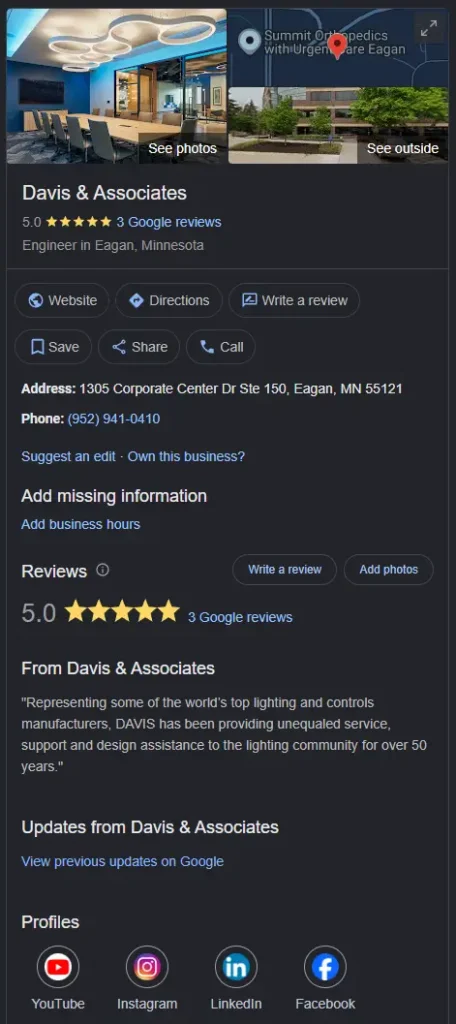
Do reviews help a law firm rank in Google AI Mode?
The reviews can help, in two ways: reviews shape the information that’s available about a firm, and they shape the decision someone makes after seeing it. Google can surface what people say about businesses across the web, and AI Mode can draw on multiple sources when it compares options. That doesn’t mean review count is some simple AI Mode ranking switch, though.
I focus on four things: authenticity, recency, relevance, and what the firm can learn from them. A steady flow of genuine reviews is far more defensible than a sudden burst. Reviews that naturally describe the kind of help, the communication, and the overall experience are useful, but firms should never script false claims or pressure clients to work in keywords. One practical tip: if you send clients an automated message asking for a review, change the template from time to time and ask them to mention different aspects of your work. Over time, that lets Google see a broad range of benefits of working with your firm, all coming from third parties rather than from you, which goes a long way toward establishing that those claims are relevant and real.
How you respond matters too, and law firms need to be careful here. A reply like “We were glad to win your injury case” confirms representation and discloses information. A neutral reply can thank the person for their feedback without acknowledging any lawyer-client relationship.
I also read reviews as intake and service data. If several people praise fast updates, that’s a real strength the firm can probably back up elsewhere. If reviews keep mentioning missed calls, no amount of AI visibility is going to fix the leads that are being lost.
Do legal directories and backlinks matter for Google AI Mode SEO?
They matter when they help with discovery, authority, identity, or corroboration. A reputable local or legal source can confirm that an attorney exists, practices in a given jurisdiction, holds a role, wrote an article, spoke at an event, or earned legitimate recognition. Strong editorial links also support ordinary Search performance, which is still the foundation AI Mode sits on.
I don’t treat “more mentions” as better visibility. Google specifically warns against inauthentic mentions, and bulk directory packages tend to create inconsistent, low-value profiles. I’d rather focus on the sources a prospective client, another lawyer, a journalist, a court, or a professional peer would actually trust.
For a medical malpractice firm in Baltimore, useful authority might come from original analysis cited by a health-policy publication, an attorney’s presentation to a professional association, a carefully maintained bar profile, or local reporting on a public case. A hundred identical biographies on obscure directories don’t create the same signal.
Backlink work should start with something worth referencing. Original research, local resources, attorney commentary, public-record analysis, and genuinely useful tools are much easier to earn links to than another generic article titled “Five Things to Do After an Accident.”
How can a law firm appear in AI Mode comparison searches?
Comparison queries come naturally out of query fan-out. A potential client might ask for the best truck accident firms in Atlanta, compare two firms side by side, look for a lawyer with trial experience, or ask what to evaluate during a consultation. Google may pull in the firm’s own pages alongside reviews, bar profiles, directories, news, and other independent sources.
I get a firm comparison-ready by stating its differentiators in concrete, verifiable terms. “We fight for our clients” gives Google and the client nothing to compare. These are the facts that tend to matter, as long as they’re accurate and permitted under the applicable advertising rules:
- the case types the firm accepts and doesn’t accept.
- the jurisdictions and courts where its lawyers practice.
- named attorneys with relevant experience and credentials.
- whether the firm handles the case itself or commonly refers or co-counsels matters.
- how consultations, communication, and intake work.
- fee structure information and responsibility for costs, with appropriate qualifications.
- documented results, representative matters, publications, leadership, and speaking experience.
- languages, accessibility, office locations, and remote-service options.
Then I check whether reputable third-party sources describe the same firm. If the website emphasizes medical malpractice but the leading profiles only mention general personal injury, Google gets a blurry picture of who the firm is. If a directory still lists former attorneys or an old office, a comparison can start from incorrect facts.
Firms shouldn’t publish pages declaring themselves “better than” named competitors without a sound legal and factual basis. A useful comparison page can instead explain how to choose counsel, which questions reveal meaningful differences, and how the firm’s own approach answers those questions. The content should help the client make a decision, not manufacture an accolade.
Does E-E-A-T matter for lawyers in Google AI Mode?
Yes, though not in the way some SEO agencies sell it. Experience, expertise, authoritativeness, and trustworthiness (E-E-A-T) are useful quality concepts, especially for legal information that can affect someone’s rights, money, freedom, family, or health. Google describes E-E-A-T as a mix of factors its systems may use to identify helpful content. It isn’t a visible score you can bump up by installing a plugin.
On a law firm site, I look for tangible evidence:
- a named attorney author or reviewer.
- a detailed bio with admissions, relevant experience, education, roles, and credible recognition.
- a clear connection between the attorney and the topic.
- links to statutes, court opinions, agencies, and other primary sources.
- dates showing when the page was published and materially reviewed.
- careful statements of jurisdiction and limitations.
- accurate firm identity, office, and contact information.
- case results and testimonials presented with required context and permissions.
- editorial standards and corrections where appropriate.
- secure, usable pages and a clear privacy policy.
I also strip out empty signals. “Our award-winning attorneys have decades of combined experience” doesn’t persuade anyone if the page never says who the attorneys are, what the awards were, or what the relevant work was. Specifics are more credible and more useful.
Build a better case acquisition system for your law firm.
Tell us about your firm and your goals. We’ll give you our honest take on how to get there.
Schema markup: useful support, not a shortcut
Schema markup can help Google understand page and entity information, but Google says there’s no special structured data required for AI Mode and warns against overfocusing on it. I use schema to support a site that’s already clear, not to make up for weak content.
For law firms, the implementations that tend to be useful include:
- Organization or an appropriate local-business subtype for firm details.
- Person and ProfilePage information for attorney profiles.
- Article markup with an identifiable author and author URL.
- breadcrumbs.
- video markup where the page contains an eligible video.
- location, contact, logo, and sameAs information that matches visible content.
The markup has to describe what a user can actually see on the page. I don’t add fake reviews, invented ratings, irrelevant practice areas, or dozens of cities to structured data. And I validate the implementation, check the rendered pages, and keep an eye on Search Console for errors.
FAQ schema isn’t an AI Mode shortcut either. A clear question-and-answer section is worth having because clients need it, but slapping FAQ markup on it doesn’t guarantee an AI citation or a rich result.
Does a law firm need an llms.txt file for Google AI Mode?
No. Google says it doesn’t use llms.txt or other special AI text files for visibility in Google Search, including its generative features. According to Google’s current guidance, creating one won’t help or hurt your rankings either way.
Some other AI platform may decide to use a file like that in the future, but that’s a separate question. For Google AI Mode, I’d rather spend the time on crawlability, indexing, content, internal links, entity clarity, page experience, and authority.
It’s a good test for any AI-search advice, by the way: if someone tells you a technical file is mandatory, ask them for the platform’s official documentation and some evidence. The AI SEO market produces confident claims a lot faster than anyone can reliably test them.
Does content need to be “chunked” for AI Mode?
No, there’s no special chunking format required. Google says its systems can understand multiple topics and relevant passages on a page. There’s no ideal word count or mandatory paragraph size for generative search.
I still structure long legal pages carefully, but that’s because people need structure. Clear headings, reasonably short paragraphs, lists where they help, descriptive anchors, and direct answers all make a page easier to use. That’s just good publishing, not some hidden AI markup trick.
I split a page when the search intent, the legal issue, or the desired action changes enough to deserve its own resource. I don’t chop one coherent answer into ten thin pages just to capture long-tail variations.
What technical SEO does a law firm need for Google AI Mode?
The bare minimum is that Google can crawl, render, index, and serve the page with a snippet. When I run a technical audit, I check that:
- the page returns a successful HTTP status and isn’t blocked by robots.txt.
- there’s no unintended noindex, nosnippet, restrictive max-snippet, or conflicting canonical.
- the main content is available to Google and not hidden behind login, broken JavaScript, or an interaction Google can’t complete.
- the canonical URL is correct and duplicate versions are controlled.
- XML sitemaps contain the canonical, indexable pages the firm wants discovered.
- internal links use crawlable links and provide a sensible path to important pages.
- mobile rendering, HTTPS, Core Web Vitals, navigation, and intrusive overlays are acceptable.
- titles, headings, and page content accurately describe the page.
- structured data is valid and matches the visible content.
- images and video have usable source files, context, and metadata.
- multilingual or multi-regional pages use appropriate signals when relevant.
- tracking doesn’t slow or break the consultation experience.
I use Search Console’s URL Inspection tool to see how Google actually views the important pages. Submitting a sitemap isn’t proof of indexing, and indexing isn’t proof of visibility. It just gets the page into the competition.
One problem I keep running into on law firm sites is a redesign that keeps the look but breaks the information architecture. Old high-value URLs get redirected to the homepage, internal links disappear, attorney pages get removed, or JavaScript starts rendering key copy unreliably. AI Mode can’t retrieve authority that the migration erased.
Can lawyers use AI-generated content for AI Mode SEO?
Yes, but how the content was produced doesn’t excuse low quality. Google says it focuses on content quality rather than whether AI was used, while scaled production of unoriginal pages primarily intended to manipulate rankings can violate its spam policies.
I use AI myself for parts of the research, clustering, transcript cleanup, structure, comparisons, and quality checks. What I don’t let it do is decide the law, invent experience, make up a citation, or publish anything without an attorney-controlled review.
My minimum workflow for legal content looks like this:
- Define the client situation and commercial purpose.
- Gather primary law and current jurisdictional sources.
- Interview the attorney or obtain first-hand notes.
- Draft the direct answer, material conditions, exceptions, and next steps.
- Verify every legal proposition and citation.
- Review confidentiality, advertising rules, claims, and required disclaimers.
- Add author, reviewer, dates, internal links, and a useful conversion path.
- Publish and monitor performance and legal changes.
An AI-generated page that just rearranges competitors’ articles gives Google no reason to cite it. A page that uses AI to organize an attorney’s original analysis can be excellent, as long as the final result is accurate and useful.
Researching AI Mode topics: start with cases, not keywords
I start with cases, not keywords. Search volume tells me roughly how often a phrase gets used in classic search, but it doesn’t show me the full conversation or which matters the firm actually wants.
My research sources include:
- intake call notes and recorded questions, where lawful and properly handled.
- consultation notes stripped of confidential details.
- rejected-lead reasons.
- questions asked in reviews, chat, email, and contact forms.
- Search Console queries and landing pages.
- Google autocomplete, related searches, People Also Ask, and AI Mode follow-ups.
- competitor and directory coverage.
- statutes, agency guidance, court resources, and procedural forms.
- forums and communities used to discover language and confusion, not as legal authority.
- manual AI Mode testing from realistic user scenarios.
Then I map each topic across four dimensions:
- Problem: What happened or what does the person want?
- Modifiers: Which facts, jurisdiction, timing, relationship, or asset changes the answer?
- Decision: What is the person deciding now?
- Next questions: What will they ask after receiving the first answer?
For a criminal defense firm in Orlando, “DUI lawyer” is just the category. The useful map might include refusing a breath test, license deadlines, the first court date, a crash with injury, an out-of-state license, a professional license at risk, and the difference between administrative and criminal proceedings. I group these into resources based on real differences in intent, not one URL per phrase.
How can a multi-location law firm rank in AI Mode?
Every location page should represent a real office or a real service relationship, and it should offer information that’s useful in that market. Swapping “Dallas” for “Fort Worth” across otherwise identical pages adds very little and can leave you with a confusing site.
For each legitimate office, I line up:
- the office page, Business Profile, contact information, and structured data.
- the attorneys and services actually available there.
- local courts, agencies, procedures, communities, and practical considerations where relevant.
- reviews and photos associated with the location.
- internal links from relevant practice and attorney pages.
- tracking that distinguishes calls, inquiries, consultations, and hires by market.
For a firm serving several North Carolina markets, I’d compare case demand against actual operating capacity before expanding the location content. A page can rank perfectly well and still attract the wrong matters or overload an office. AI Mode SEO should follow the firm’s growth strategy, not draw a map of cities the firm can’t serve well.
Virtual-office and service-area tactics need care too. The Business Profile has to comply with Google’s rules, and the website shouldn’t imply a staffed office where there isn’t one. Clear, truthful market coverage lasts longer than a location footprint built for appearances.
How do personal injury lawyers optimize for Google AI Mode?
Personal injury searches mix local intent, urgent decisions, medical questions, insurance issues, liability, damages, and trust all at once. I build the strategy around the accident and injury case profiles the firm wants, then connect those to local evidence and attorney experience.
For a trucking practice in Georgia, that could mean preservation of electronic logging and vehicle data, motor-carrier relationships, multiple insurance layers, federal safety rules, catastrophic injuries, and local filing considerations. For a smaller suburban practice, the priority might instead be ordinary crash cases in markets where the firm’s acquisition cost and operating model actually work.
The content has to steer clear of medical advice, overstated outcomes, and turning every injury into a promise of compensation. Case results need context and the required disclaimers. Client stories need permission and careful handling of confidential information.
I also make the immediate next steps clear: preserve evidence, get appropriate medical care, avoid social posts that could damage the claim, understand how the insurer will approach you, and talk to a lawyer when needed. Someone arriving from AI Mode may already know the general rule. The firm earns the inquiry by making the next step safer and clearer.
How do family law firms optimize for Google AI Mode?
Family law questions are highly fact-specific and emotionally charged. People often ask AI Mode long questions that bring in relationship history, children, property, relocation, safety, and jurisdiction all at once. Generic definitions are rarely enough.
I structure content around decisions: whether to file now, what temporary relief may be available, how property or support may be handled, what evidence to preserve, how relocation or protective orders affect the process, and when urgent legal help is appropriate.
For a family law firm in Chicago, a useful page might explain the difference between a true emergency and a dispute that goes through ordinary motion practice, using Illinois terminology and local context. What it shouldn’t do is invite someone to type sensitive facts into an insecure form.
First-hand attorney input matters a lot here. The most useful material usually explains the process and sets expectations without predicting an outcome. Tone matters too. Alarmist content can bring in clicks and poor-fit consultations while quietly damaging trust.
How do criminal defense lawyers optimize for Google AI Mode?
Criminal searches usually come with urgency, a location, an offense, a stage of the case, and immediate risk. The page should tell the reader what to do now, what not to do, and how the process works, without implying any guaranteed result.
I prioritize offense pages, local process, arrest and bond questions, license or employment consequences, evidence issues, and pages for the common decision points. Clear attorney availability and intake routing matter here because the search often happens at night or right after an arrest.
For a defense firm in Nashville, I might build an answer around what happens after a domestic assault arrest, including release conditions and contact restrictions. The page has to keep general information separate from advice, and it shouldn’t lead someone to violate an order based on an AI-generated summary.
Authority comes from accurate local knowledge, named attorney experience, and reliable sources. Repeating the statute isn’t enough.
How do immigration lawyers optimize for Google AI Mode?
Immigration law marketing has to keep up with changing rules, federal processes, country-specific facts, and urgent deadlines. A stale page here isn’t just useless, it can be actively harmful.
I build strong service pages for the matters the firm accepts, plus supporting resources for specific procedural situations. Every page should say which date, agency, form, or policy it’s referring to where that’s relevant, and make clear at what point someone needs individual advice.
Because immigration firms often serve clients across the country or internationally, local SEO isn’t the whole strategy. For some practices, language coverage, attorney credentials, service eligibility, remote consultation logistics, and reliable translations matter more.
I’ve found that the language clients use is very different from agency terminology. Someone might search “green card through marriage after visa expired,” while the legal analysis is about entry, status, admissibility, adjustment eligibility, and other facts. A strong page starts with the client’s question and then introduces the legal distinctions clearly.
Content freshness: update only when the law changes or there are new things to add
Update it when the law, the procedure, the facts, or the usefulness of the page changes. I don’t bump a date every month just to fake freshness.
My review schedule depends on risk:
- pages about rapidly changing agency policy, filing rules, benefits, or deadlines receive frequent review.
- core evergreen service pages receive scheduled substantive review and ongoing performance review.
- commentary on a decision is updated when later authority changes its meaning.
- statistics retain the date and source of the dataset.
- attorney, office, and contact information is corrected immediately.
- pages with declining visibility or conversion are reviewed for intent, accuracy, competition, and user experience.
A page should only show a “last reviewed” date when someone actually reviewed it. I keep an internal record of what changed and who signed off on the legal substance.
How do I test whether my law firm appears in Google AI Mode?
Manual testing is useful, but a screenshot isn’t measurement. Responses vary by location, language, device, history, personalization, and whatever Google changed that week.
I put together a prompt set based on real client situations and test it consistently. The set includes:
- broad service searches.
- high-intent local searches.
- fact-rich problem searches.
- comparisons and “best” or “who handles” searches.
- attorney and firm entity searches.
- follow-up questions that move from education to selection.
- prompts for priority case profiles and known poor-fit profiles.
For each test, I record the date, the location or test market, the prompt, the response type, the cited pages, the firms named, and the stage of the client journey. One good result doesn’t mean victory, so I don’t treat it that way.
I also go looking for errors. If AI Mode gets the firm’s office, attorneys, services, or results wrong, I trace the sources and correct whatever the firm controls. Surprisingly often, the wrong fact comes from the firm’s own neglected profile.
How can lawyers measure AI Mode traffic in Google Search Console?
As of 2026, Google provides a Generative AI performance report in Search Console. It shows impressions from supported generative AI features and can be grouped by pages, countries, and dates. Google also explains that clicks on external links in AI Mode count as clicks, and follow-up questions are treated as new queries for reporting purposes.
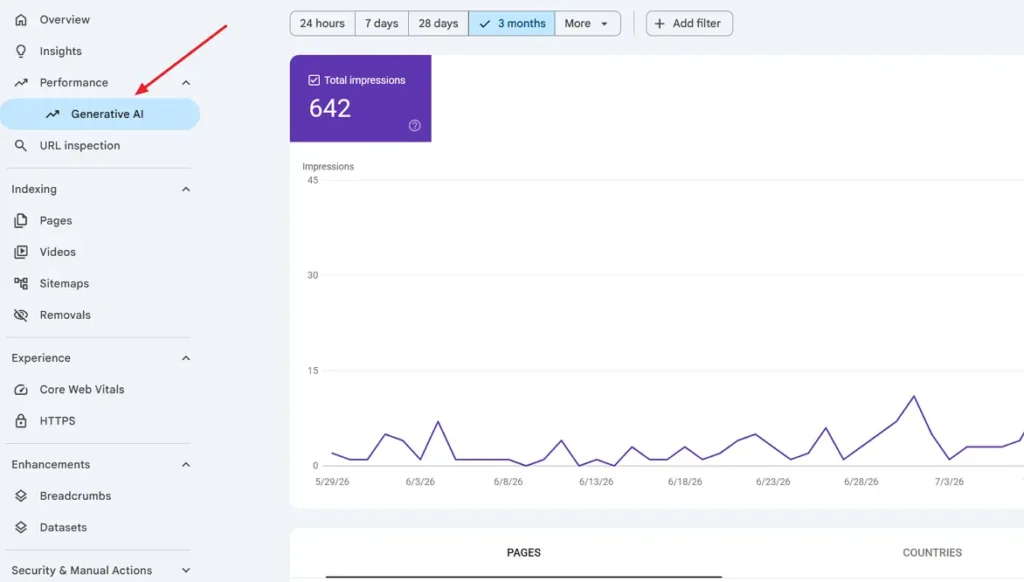
I use that report to answer three questions:
- Which pages are gaining generative-search visibility?
- In which markets is the visibility appearing?
- Is visibility growing after substantive work on the relevant topic?
But I don’t stop there. Search Console visibility is an early indicator, not a signed case.
Tracking has its limits. Product reports change, low-volume data gets hidden, and personalization makes manual rank checking unstable. Third-party platforms can help organize prompt monitoring, but they don’t have Google’s internal ranking data. I treat their visibility scores as directional observations, not as revenue.
How do I track leads and signed cases from Google AI Mode?
The cleanest way to measure this connects web analytics, calls, forms, chat, the CRM or intake software, consultations, hires, and revenue. AI Mode clicks still show up as Google organic visits, so the landing page and session data won’t always give you a neat “AI Mode” label.
I combine several sources:
- Search Console’s generative AI reporting.
- analytics landing-page and organic-search trends.
- call tracking with appropriate source persistence.
- form and chat attribution.
- intake questions such as “What did you search for?” and “Where did you first hear about us?”.
- CRM records for consultation, hire, case type, market, and revenue.
- branded-search changes after the firm’s AI visibility grows.
Self-reported attribution isn’t perfect, but it catches journeys that analytics misses. Someone might see the firm in AI Mode, come back later through a branded search, and call from the Business Profile. Last-click reporting would hand all the credit to that final step.
At Pioneerly, I care more about cost per signed case and return by channel or market than raw lead volume, and I hold AI Mode to the same standard. Ten citations for informational questions outside the firm’s jurisdiction can easily be worth less than one qualified consultation on a priority matter.
How long does AI Mode SEO take for a law firm?
There’s no reliable fixed timeline. Technical fixes can affect eligibility as soon as Google recrawls and reindexes the page. New content and authority work can take months to produce visibility that sticks. Competitive local markets and new domains usually take longer than an established firm improving pages Google already trusts.
So instead of promising a citation date, I set milestones:
- technical blockers resolved.
- priority pages indexed and internally connected.
- entity and location inconsistencies corrected.
- first-hand content published and reviewed.
- relevant authority and corroboration improved.
- generative impressions and cited-page coverage expanding.
- qualified organic inquiries and signed cases improving.
AI Mode itself changes quickly. A tactic that looks effective in one interface test can vanish after a product update. The work that lasts is the work that also makes the firm clearer, more useful, and more credible in ordinary Search and to prospective clients.
What are the biggest AI Mode SEO mistakes law firms make?
These are the mistakes I see most often:
Treating AI Mode as a separate hack
The firm buys an “AI optimization” add-on while its important pages aren’t indexed, its locations conflict, and its practice content is generic. Fix the foundation first.
Publishing commodity content at scale
Hundreds of AI-generated city and question pages add almost nothing original and put the site at risk. Google explicitly warns against scaled unoriginal content produced to manipulate rankings.
Confusing mentions with qualified visibility
A firm celebrates being named for a broad question but can’t connect the exposure to a desired case, market, or action.
Ignoring local business data
The website says one thing, the Business Profile says another, and directories still list old attorneys and addresses. All that gives AI systems more conflicting information, not more authority.
Writing only educational content
The site answers legal questions but never makes clear which matters the firm handles, where it practices, or how to begin a consultation.
Writing only sales copy
The service pages claim the firm is aggressive, experienced, and compassionate but contain nothing worth retrieving for a substantive question.
Overstating legal answers or results
Direct answers are valuable. False certainty isn’t. Jurisdiction, facts, exceptions, and advertising rules still apply.
Relying on one tracking tool
No external platform has Google’s internal AI Mode ranking data. Prompt trackers, Search Console, analytics, intake attribution, and case outcomes each show a different part of the picture.
Forgetting conversion and intake
The firm gets visible, but calls get missed, forms are too long, follow-up is slow, or the intake team can’t tell what kind of case it is. Traffic without operational follow-through isn’t growth.
The first 90 days: a working plan
I’d spend the first three months building a reliable base and producing evidence, not chasing hundreds of prompts.
1. Establish the baseline
Take stock of indexed pages, Search Console performance, generative AI visibility, Business Profiles, priority case types, locations, conversion paths, and current lead quality. Build a repeatable prompt set and record what AI Mode currently cites.
2. Remove technical and entity blockers
Fix crawl, indexation, canonical, rendering, snippet-control, internal-link, mobile, and speed problems on priority pages. Correct firm, attorney, office, category, phone, and credential inconsistencies across the website and important external profiles.
3. Improve the pages closest to revenue
Rewrite or expand priority practice pages using attorney input, local context, useful proof, and a clear consultation path. Don’t start churning out low-value blog posts while the pages meant to generate cases are still weak.
4. Fill the most important information gaps
Create supporting resources for the questions and follow-ups that matter to priority cases. Add original explanations, primary sources, useful visuals, and clear authorship.
5. Strengthen legitimate authority
Publish or promote material that deserves references. Correct reputable profiles, document real speaking and authorship, and pursue relevant local or industry coverage. Avoid bulk mention schemes.
6. Connect visibility to intake
Make sure calls, forms, chats, consultations, hires, case types, markets, and revenue can all be followed through the firm’s systems. Then look at the first data for quality, not just quantity.
By day 90, I want to know whether the foundation is sound, whether Google can retrieve the right pages, whether generative visibility is expanding in priority topics, and whether the firm is seeing better opportunities. I don’t promise that every target prompt will cite the firm. No honest SEO can.
Is AI Mode SEO worth it for law firms?
Yes, as long as it’s part of sound law firm SEO and measured against cases. AI Mode is becoming part of how people use Google, especially for complex questions, comparisons, and follow-up research. Legal problems fit that behavior naturally.
The business case isn’t “AI is the future.” It’s that a growing part of Google Search now retrieves, combines, and presents information differently. A firm that’s technically eligible, locally clear, useful on the substance, well corroborated, and easy to hire gets more chances to show up across ordinary results, Maps, AI Overviews, and AI Mode.
I wouldn’t pour the whole marketing budget into speculative AI visibility while neglecting the channels that are already producing cases. I’d get the firm’s existing SEO to the point where it can compete in generative Search, then invest further where the query patterns and case economics support it.
The goal isn’t to be cited everywhere. It’s to be present when the right person, with the right legal problem, in a market the firm serves, is deciding what to do and whom to trust.
Frequently asked questions about AI Mode SEO for lawyers
Can I pay to rank my law firm in Google AI Mode?
Not in the organic sense. Organic citations can’t be bought. Google has been developing and testing ads inside its AI search experiences, but ads and organic source selection are separate systems. Any paid campaign should be judged on lead quality, signed cases, cost per case, and compliance with legal advertising rules. You can, however, retain a professional legal SEO firm like Pioneerly to optimize your website and brand and make it more visible in AI Mode using white-hat techniques.
Is AI Mode the same as an AI Overview?
No. An AI Overview appears within a standard Google results page for some searches. AI Mode is a conversational search experience designed for more detailed questions and follow-ups. They share important underlying search and retrieval principles, but the interfaces and user journeys differ.
Does a law firm have to rank on page one to be cited in AI Mode?
Not necessarily. Google doesn’t say a page needs a top-ten blue-link position. It does need to be indexed and eligible for Search, and the ordinary ranking and quality systems feed into retrieval. So strong organic visibility helps, but AI Mode can pull sources from across the related fan-out queries rather than just copying the first result for the original wording.
Can a new law firm appear in AI Mode?
Yes, but a new firm starts out with limited history and corroboration. I’d focus on accurate entity and location information, strong priority service pages, named attorney expertise, useful local or practice-specific content, and real relationships that produce independent references. A new firm shouldn’t try to match the content volume of a 20-year-old competitor.
Should every law firm page have a question-and-answer format?
No. Use questions where they match how clients actually look for the information. Service pages, attorney profiles, case studies, data reports, tools, and procedural guides may all need different structures. Clarity matters more than forcing everything into a template.
Can I block my content from Google AI Mode but keep ordinary rankings?
Partly. Google uses Googlebot controls for Search and offers snippet controls such as nosnippet, data-nosnippet, and max-snippet. Tighter controls can limit how content appears in AI features, but they can also affect how it appears in ordinary Search. Google’s current site-owner guidance doesn’t describe any separate “AI Mode only” switch. Think through the consequences before you change any directives.
Does Google-Extended control AI Mode?
No. Google’s Search guidance says Googlebot controls access for Search, including AI features. Google-Extended applies to training and grounding in certain other Google systems, not inclusion in Google Search features.
Should a law firm optimize for Google AI Mode, ChatGPT, Gemini, and other AI search tools separately?
The foundation is largely shared: accessible content, clear entities, original expertise, authoritative references, local accuracy, and strong service pages. But each platform has its own retrieval sources, controls, and reporting, so testing and measurement should be done per platform. Don’t assume a citation in one system means visibility in another.