



Most personal injury firms I meet for the first time already spend real money on marketing. When I start working as their fractional law firm CMO, their partners rarely ask me if scaling their marketing is the way to go. They want to know how to bring in cases more consistently, how to make revenue more predictable from month to month, how to compete with firms that can outspend them, and how to attract the kinds of cases their firm was built to handle.
In this ultimate guide to personal injury marketing, I’m going to share my own insights and experience from working with fast-growing personal injury firms across America. I’ll also provide real market data and numbers based on Pioneerly’s personal injury marketing benchmarks to give my recommendations the right context and necessary market perspective. The Pioneerly team mystery-shopped 214 personal injury firms by phone and online across 12 metros. They also analyzed anonymized client data on marketing spending, leads, and signed cases, and tracked how personal injury firms show up in Google Maps, paid search, reviews, and recommendations from AI assistants.
This guide is not for small personal injury firms just starting out – unless you have high ambitions, want to grow fast, and have the resources to put behind your aggressive growth strategy.
What does it cost your personal injury firm to sign a case?
Before you can start building out and optimizing your marketing strategy, you need to know the answer to this question. Everything else revolves around it – your marketing can only be as good as the case economics that were laid out as its foundations.
You want to figure out this metric for every major case type your firm handles. Average cost to sign a case is a meaningless number if it includes both soft tissue injury and complex nursing home abuse cases. You might be tempted to group the case types by fee amounts they produce ($5,000-$10,000, $10,001-$20,000 and so on), but I’ll ask you to resist that. Understanding the cost per case type is crucial for designing the right marketing strategy. The average fee you collect doesn’t dictate how and where you’ll do your marketing. And you will calculate the average fee per case type separately, anyway.
Go back at least 12 months (longer for more complex case types). Include agency fees and the share of intake payroll devoted to handling marketing inquiries. Divide that total by the number of cases those inquiries produced. Rinse and repeat for all major case types you handle.
To see how much of your fee goes toward acquisition, divide the cost per signed case by the average fee on comparable closed matters. For this metric, you can go as far back as your records allow. Again, run the calculation separately for your major case types. Combining soft tissue injuries with complex medical malpractice cases can hide an expensive campaign in an otherwise healthy average.
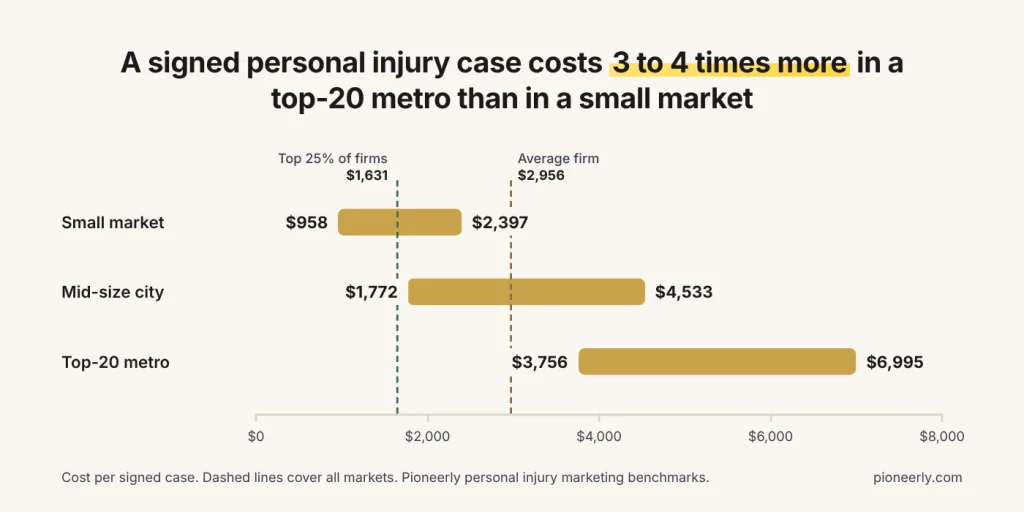
In our benchmarks, the average personal injury firm pays $2,956 per signed case, compared with $1,631 for the top quarter. Average fees are $16,538 and $26,665, respectively. We also tracked acquisition cost as a share of the first fee (18.5% and 8.1%) and fees earned per marketing dollar ($4.78 and $9.30). Each figure is a separate benchmark, so you shouldn’t do any arithmetic on the numbers together.
Geography changes the math. A signed case costs $958 to $2,397 in a small market, $1,772 to $4,533 in a mid-size city, and $3,756 to $6,995 in one of the 20 biggest metros. Take a case that earns a $26,665 fee. At $1,631 to sign it, you earn about $16 in fees per acquisition dollar. At $6,995, you earn less than $4, before you account for the work it took to handle the case.
If your firm focuses on a narrow practice, such as complex nursing home abuse cases, your own closed files will tell you more than a national average across all case types. Look at the fees you collected, the cost of preparing and litigating those matters, and how long you waited to get paid. That gives you a basis for deciding how many cases you want and what you can afford to spend to sign one.
1. Fix your intake before you spend another dollar on marketing
When a partner at a personal injury firm asks me where to put the next marketing dollar, my first question back is usually about intake. What happens if I call your firm tonight? How easy is it to schedule a consultation on the website? How fast will I receive a call back? Will I know the name of the attorney I’m meeting with? If I want, will I be able to sign the retainer during the call? If I forget about my consultation, will you remind me about it in five different ways?
As a Growth Counsel at Pioneerly, I work on both marketing and intake optimization, and I often find that the quickest way to sign more cases is to be better at capitalizing on the opportunities that have already been generated by marketing. This means being extra fast and efficient across the client journey from the first click to a signed retainer, being proactive, and mapping out each step of that journey to deliver the best possible experience across all of those steps.
The Pioneerly team submitted realistic (we really went the extra mile to make sure those were as real-world-resembling as possible) web inquiries to 214 personal injury firms. More than a quarter (26.5%) never replied. Among firms that did, the first response during office hours took 15.7 minutes on average. Only 25.5% replied within five minutes. When we called, 25.6% of calls went unanswered. Coverage was especially thin on weekends, even though roughly a third of inquiries in our benchmarks came in outside office hours.
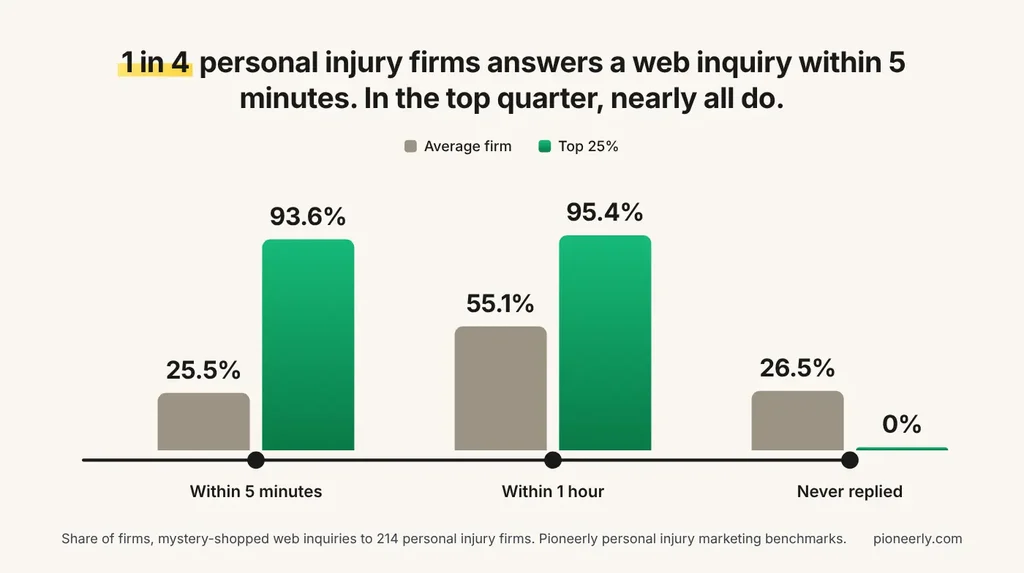
In the top quarter, firms answered at least 93.6% of web inquiries within five minutes. Their typical response took less than two minutes, fewer than 4.7% of calls went unanswered, and a person answered 96.3% of after-hours contacts. These firms signed 21.7% of inquiries, compared with 10.6% on average. That’s about 22 clients from 100 inquiries versus 11. We help firms close that gap through our lead management plan. If you’re doing the work in-house, I’d start here before improving marketing.
Set a five-minute response goal for web forms, chats, and texts
Decide who covers nights and weekends. For someone who requests a callback, call first and follow up by text if appropriate. Firms I work with often use a rotating intake shift or a legal answering service and automate the initial acknowledgment (not the callback itself). Make sure someone owns the conversation after that first message.
Answer calls live
When everyone on intake is busy, route the next call to a trained backup. Don’t waste your time and resources on an AI phone answering service. This is when revenue is lost. Only a fraction of potential clients will want to speak to an AI voice agent compared to people willing to talk to a person. Don’t use a traditional answering machine, either. Every single call needs to be taken by a real person, well trained in handling the initial calls with accident victims or their families.
Design a follow-up campaign for every person you haven’t reached via phone
The average personal injury firm follows up once or twice. The top quarter makes 9 to 14 attempts over 13 to 31 days. Prepare the calls, texts, and emails in advance, respect the person’s contact preferences and bar rules, and stop or adjust the sequence when they respond, decline, or ask you to stop.
Make it possible to sign on the first call
Top-quarter firms typically get a signed agreement the same day. The average firm takes 3.2 days. If the case is a fit and the caller wants to hire you, send the retainer while you’re on the phone. Give them time to read it and someone who can answer their questions.
Give each consultation a time and a name
Top-quarter firms book consultations with 83.7% of qualified leads, compared with 70.7% on average. Of those booked, 98.6% take place, compared with 81.4%. Tell the caller which attorney they’ll meet, then send at least two reminders: the day before and an hour before the appointment.
Record how each person found you
Use a tracking ID for each channel and capture the source on your web forms. On top of that, open every consultation with some version of “How did you first hear about us?” Someone who clicks a Google ad may have heard your name from their family lawyer. You want to record both the source your analytics software sees and what the client says themselves.
2. Build your Google Business Profile and ask clients for reviews
Google Maps was the fastest organic route to visibility in our benchmarks. The top three spots on Google Maps took the average firm 3.4 to 6.4 months to reach, compared with 2.0 to 2.8 months for the top quarter. Page one in the regular search results took roughly 9 to 24 months. A Maps listing generated an estimated 17 calls and 29 website clicks a month for the average firm, compared with 88 calls and 114 clicks for the top quarter.
Start by looking up your firm the way a prospective client would. Can they recognize the office, see whether you handle their kind of injury, and tell whether someone will answer if they call now?
Then read the latest reviews. For someone choosing between three local firms, a former client’s account of how often their lawyer called back can answer a question the listing itself can’t.
Complete the profile for each eligible office
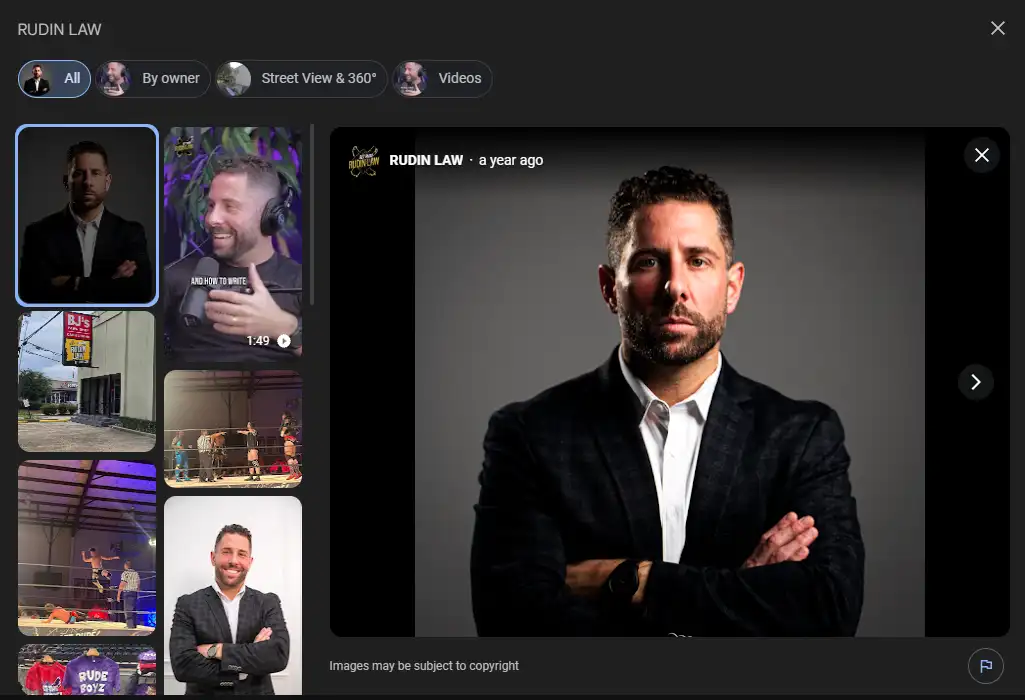
Choose the most accurate primary category, such as “Personal injury attorney,” and list your case types under services. Check the name, address, phone number, and hours against your website and bar directory. Add current photos of the office and attorneys, and say which counties you serve.
Set up an office for each priority location in the area you serve.
The location of the user determines the results they see when searching for an attorney. If your office is located 50 miles away, firms with less optimized GBPs and worse reviews will outrank you. To give yourself a boost in visibility, open the office in that area. It can be a cheap by-appointment-only office that doesn’t have staff working there every day. Open, optimize, and maintain a Google Business Profile for each of these offices, and you’ll see a huge difference in visibility and leads.
Build a better case acquisition system for your law firm.
Tell us about your firm and your goals. We’ll give you our honest take on how to get there.
Keep your profile active
Update your profile when prospective clients would benefit from the news. If you move, show the new entrance and parking. If your phones are staffed over a holiday, update the hours. A prospective client deciding whether to make the trip has a reason to care about both.
Ask for a review at a consistent point in every case
When the matter closes, the attorney who handled it can send a brief thank-you and a direct link to the right office’s profile. Invite clients to describe their experience in their own words and leave it to them to decide what they’re comfortable sharing publicly.
Assign someone to respond to reviews
The average PI firm responds to 36.2% of reviews, compared with at least 80.8% for the top quarter. For a complaint, acknowledge the concern without confirming the relationship or disclosing case details. Give the reviewer a way to reach someone privately who can help.
Use posts to answer common questions
A short attorney introduction or a post explaining what to bring to a first consultation gives callers a sense of what to expect. Start with the questions your intake team heard this week.
Table 1. Review counts and ratings among PI firms in the Google Maps top three
| Market | Average firm in the top three | Top 25% in the top three |
|---|---|---|
| Mid-size city | 140 reviews, rated 4.54 | 394 reviews, rated 4.84 |
| Big city | 550 reviews, rated 4.18 | 1,046 or more reviews, rated 4.51 |
| New reviews per month | 0.94 | 8.9 or more |
| Reviews receiving a reply | 36.2% | 80.8% or more, usually within two days |
To enjoy the best possible click rates from your Google Business Profile, you want your star rating to be between 4.7 and 4.9 (5.0 has a worse click-through rate than this range). In our benchmarks, 69.7% of people read reviews before calling a lawyer. Someone comparing two firms may learn more from several recent reviews than from a higher rating based on a handful of older reviews. We help firms manage this through our law firm review management service.
3. Get the most out of your Local Services Ads
Two-thirds of personal injury firms already run Google’s Local Services Ads, rising to 87% or more among the top quarter. If your firm isn’t using them, make getting started a priority. If you already are, focus on closing the gap between your current results and what the best-performing firms achieve.
In our data, LSAs had the lowest cost per signed case of any paid channel: $1,657 for the average firm and $884 for the top quarter, compared with $3,123 and $1,693 through Google Ads. LSAs charge per lead, with an average cost of about $238. To see whether they’re a good buy locally, follow those calls through intake.
Check your setup against the case types you actually want.
If you’re starting, complete Google’s screening and verification process. If you’re already running LSAs, review your selected service areas and case types. An account set up two years ago may no longer reflect the practice you’re building today.
Answer every LSA call live, in seconds.
Missed calls can affect your ranking as well as your conversion rate. Route calls to the intake team member who can respond fastest, with overflow coverage when they’re busy. Check the pickup times and missed calls, especially during lunch, evenings, and weekends.
Review lead quality and credits every week.
Google automatically assesses leads and may credit poor-quality ones. Use the lead feedback survey, check which charges were credited, and investigate recurring unwanted inquiries. Don’t assume a call your firm declines qualifies for a refund: Google no longer supports credits for services or geographic areas you don’t cover. Fix those mismatches in your targeting.
Set the budget around signed cases and intake capacity.
For a new account, choose a starting budget your team can comfortably handle. For an existing account, increase spend when the cases justify it and intake has room. Use the $1,657 average cost per signed case as a reference, then set your own target around case type, expected fees, and local competition.
Keep the review count climbing.
Your review count and rating affect LSA ranking, so the review management process from the previous section supports this channel too. Make asking for reviews part of the client experience, with someone responsible for following through.
Trace lead quality back to geography and case type.
Connect LSA inquiries to your intake records and compare which locations and matters produce signed cases worth pursuing. A county generating cheap calls may still be expensive if few of those calls qualify. Use a meaningful sample of completed intake outcomes to refine your service areas and selected services.
Test bidding changes against cost per signed case.
If you’re using manual bids, test Maximize Leads with a fixed budget and keep other major settings stable. Allow time for bidding to adjust and for the resulting inquiries to complete intake. Then compare the number, cost, and types of cases you signed.
Run LSAs alongside Google Ads, and track their results separately. LSAs give prospective clients a direct route to contact your firm, while search ads let you build campaigns and landing pages around specific case types. Allocate budget based on the cases each channel brings.
4. Run Google Ads by case type and keep optimizing the landing pages
Personal injury clicks can be expensive enough that one search term changes the economics of a campaign. Our benchmark is about $126 in a mid-size city, $43 to $85 in a small market, and $141 to $426 in a big city. Truck and motorcycle terms can run $515 to $908. For “car accident lawyer,” firms pay $71 to $159 per click in mid-size cities and $291 and up in the biggest metros.
At Pioneerly, we track bids metro by metro to decide where a client’s budget can compete. In Atlanta, for example, Google’s estimated top-of-page bid for “personal injury attorney Atlanta” ranged from $52 to $220 over the 12 months to November 2026, with roughly 5,000 monthly searches across the metro. The bid range helps us price a test. The campaign itself tells us what the firm actually pays.
What happens after the click explains much of the difference between firms. The average firm and the top quarter pay roughly the same per click, and their click-through rates are fairly close (6.3% and 7.7%). But the top quarter converts 11.9% of clicks into inquiries, compared with 5.9% on average. Half of its inquiries qualify as potential cases, compared with 39.1%. By the time a client signs, the difference is $1,693 per case versus $3,123. If your clicks are already expensive, look at the landing page and intake records before raising the bid any further.
Give each case type its own campaign and budget.
A $600 truck accident click can quickly use up money you meant to spend on $90 car accident clicks. Separate those campaigns and skip case types whose likely fees can’t support the local cost of acquisition.
Match the landing page to the search.
Someone searching for a truck accident lawyer in Fort Worth should reach a page about that practice in Fort Worth. Show who would handle the case, the counties you serve, and any relevant results you can share. On a phone, keep the call button visible and the initial form short.
Target the counties you serve and check when calls come in.
After a month, compare inquiries and signed cases by county and time of day. If evening calls look promising but few get answered, fix coverage before increasing evening spend.
Build a negative keyword list before launch.
Start with plainly irrelevant searches such as “jobs,” “salary,” and “how to become a lawyer.” Review actual search terms weekly for the first two months, including the queries that produced qualified calls, before excluding broader phrases. If your list of negative keywords doesn’t get extremely long over time, you’re doing it wrong.
Connect each campaign to signed cases.
Track calls and forms by landing page and record which inquiries eventually sign. Where your privacy obligations and platform rules allow, use appropriate offline conversion signals for bidding. Keep sensitive case details in the firm’s intake system.
Compare lead costs with your market.
A click-to-lead rate above 9% is a useful working target. Our Google Ads lead-cost ranges extend to $221 in small markets, $301 in mid-size cities, and $976 in the biggest metros. Judge any outlier against the fees and case types it brings in.
Test the landing page as inquiries come in.
If people tap the call button but few reach intake, test the phone routing first. If mobile visitors start the form and abandon it, try shortening it. Change one thing at a time and check whether the additional inquiries qualify. Your landing pages are one never-ending experiment.
Use Meta ads to reach potential clients before they search
Someone searching Google for “truck accident lawyer” has already decided they want to hear from an attorney. Someone scrolling Facebook or Instagram may still be trying to figure out what to do after a crash. Give that person a concrete reason to stop and listen. A local attorney explaining what to expect when the trucking company’s insurer calls has a better starting point than another ad promising to fight for maximum compensation.
Build the ad around one question your intake team hears every week. Ask the people who answer your phones what callers want to know before they’ll book a consultation. For a car accident campaign, that might be what to do when the other driver’s insurer asks for a recorded statement. Have one of your attorneys answer that question in a short, captioned video, then invite viewers to call. Keep the wording general so the ad doesn’t imply you know anything about the viewer’s injuries or medical history.
Give people an easy first step. Test a short Meta lead form against the landing page you already use for that case type. Keep the offer and creative the same so you can compare the two. On Meta, ask for contact details and the best time to call. Save questions about injuries, treatment, and the circumstances of the crash for a private intake conversation.
Make the callback recognizable. Use the confirmation screen to tell people which firm will call, from what number, and how soon. Send the inquiry straight to intake. When your team calls, open with the reason the person reached out: “This is Sarah from [Firm]. You asked us to call about a car accident consultation.” That gives someone who filled out a form on their phone a moment to place the call.
Judge each ad by the cases it brings in. Record the ad and case type in your intake system, then compare how many inquiries you reached, how many qualified, and how many signed. If a $50 lead takes 50 inquiries to produce one signed case, that case costs $2,500. An ad with $100 leads that signs one in ten costs $1,000 per case. Use those numbers, along with the kinds of cases you signed, to decide which ad gets more budget.
For other paid social channels, pick one based on who you need to reach and what your firm can produce consistently. YouTube is a natural fit for attorney explainers, TikTok for short videos built around common questions, and LinkedIn for reaching professional referral sources. Give each channel a specific job and goal before you decide to spend money on it.
5. Make it easier to contact your firm online
Most visitors see your website on a phone. Mobile accounts for 79.3% of visits on average and at least 85.2% at top-quarter firms. Yet the average mobile page takes 3.26 seconds to load, and only 37.2% of PI sites pass Google’s speed test. The average PI site turns 3.1% of visitors into leads, compared with 6.3% for the top quarter. Online booking is another difference: 21.7% of firms offer it, compared with 50.8% of the top quarter.
Open your busiest page on your own phone. Someone who wants to speak to a lawyer should be able to call with one tap. Someone still figuring out whether they have a claim should be able to find an answer and get back to that same phone number.
Design the experience on your website for someone using a phone.
Keep a tap-to-call button within reach, offer the option to text you if your team can monitor the inbox, and ask only for the details you need to respond. Aim to load the page in under 2.5 seconds and test it on a mobile connection.
Offer chat or text where someone can answer.
These channels account for 8.9% of contacts at the average PI firm and 20.6% at top-quarter firms. If chat is offline, say when a visitor can expect a reply and offer a number they can call now.
Let people book a consultation online.
A calendar showing actual availability lets someone make an appointment after hours. About half of top-quarter firms offer online booking.
Build service and city pages before adding more blog posts.
Guides and articles attract 65.6% of organic visitors, but service and city pages account for 74.6% of organic leads at top-quarter firms. A reader who finds your guide to what to do after a crash should be able to reach the page for your Sacramento car accident practice in one tap. Give each main case type and office its own page. Add a city-specific practice page when you have something local to say, such as who handles those cases or where a client can meet them. That’s part of our SEO & AEO plan for personal injury law firms.
Show visitors who would handle their case.
Put the attorney’s photo and bar admissions on the relevant service page, alongside client reviews and case results you can share under your state’s advertising rules.
Track what happens after someone visits.
Set up separate analytics events for calls, completed forms, and booked consultations. Match those inquiries with intake outcomes so you can see which pages bring the cases your firm wants.
6. Earn organic and AI search visibility
Organic search, including Maps, brings the average personal injury firm 25.7% of its leads at $329 each. For the top quarter, the figures are 41.5% and $194. Those returns take time. For “personal injury lawyer [city],” the average firm reached page one in 12.8 months in a mid-size city and 15.5 to 24.4 months in a top-10 metro. Top-quarter figures were 9.1 and 10.2 months, respectively. Average monthly SEO fees in our data were $8,488 overall and $14,603 for the top quarter. Pioneerly’s SEO & AI Search plan falls around the middle of that range and it’s the best service covering both SEO and AEO on the market right now.
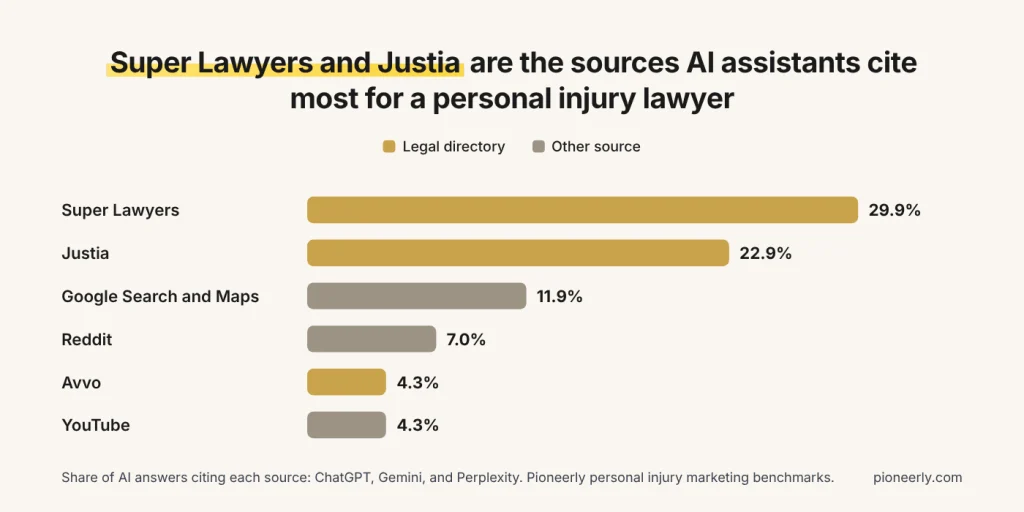
Even a page-one ranking reaches fewer people when the search results answer the question directly. Pew Research Center found that Google users clicked a result on 8% of visits with an AI summary, compared with 15% without one. We also tracked which firms ChatGPT, Gemini, and Perplexity named when asked for a local injury lawyer. The average firm appeared in fewer than 1.1% of answers, while leading firms appeared in 20.3% to 33.5% of answers about their city. The sources varied, but Super Lawyers (29.9%) and Justia (22.9%) featured most often. AI assistants accounted for 1.5% of leads on average and 3.6% for the top quarter.
Improve the pages where people decide whether to call.
Start with your main case types and office locations. A useful local page tells an injured reader which attorney handles cases in their county, where they can meet, and what to bring. I see established PI firms spending six or seven figures on marketing while sending paid and organic visitors to pages that barely answer those questions.
Describe your firm consistently online.
Search engines and AI assistants need to connect your attorneys, offices, and areas of practice with the same firm. Check how you’re described on your website, Google profiles, and directories. Use structured data on your site to identify the firm and its attorneys. Local reporting, bar publications, and speaking engagements can give people independent sources for the same information.
Update the directory profiles that appear in local searches.
Super Lawyers, Justia, and Avvo all appeared in our AI tests. Claim the profiles available to your attorneys and check their firm name, phone number, office address, bar admissions, photos, and case types against your website.
Give every attorney a bio worth reading.
Name the courts where they practice, the cases they handle, and any results, publications, or speaking engagements they can share. Include a current photo and link to their bio from the pages they write or review.
Answer the question that brought the reader to the page.
If the title asks how long a Georgia car accident claim takes, have an attorney explain the main factors in the opening paragraph. Distinguish the filing deadline from the time a claim takes to resolve. Then link to the service page for readers who want advice about their own case.
Record short answers to common questions.
A 60- to 90-second video of an attorney answering one question can work on YouTube and on the firm’s Google profile. Put the question in the title and add captions. YouTube appeared in 4.3% of the AI answers we tracked.
Write about what you know firsthand.
Your attorneys know which records an insurer usually asks for, what happens at a local scheduling conference, and which questions surprise clients at a deposition. Pick one and explain it as you would across the table from a client. Those details give someone a reason to read your firm’s answer.
We’ve written about the Google side of this in AI search vs SEO for law firms and about whether local SEO is worth it for personal injury lawyers.
7. Build a referral system for your personal injury firm
Referrals bring the average personal injury firm 37.4% of its signed cases. Past clients (15.7%) and other lawyers (15.4%) are the largest named sources, followed by other professionals (5.4%). The top quarter gets 55.6% or more of its cases through referrals. Only 25.7% of PI firms have a referral program, compared with 95.4% in the top quarter. A recommendation also sends people back to your website and reviews. Among consumers who receive a personal recommendation, 74% still look the firm up online before calling.
Most firms I meet already get referrals. Often one partner keeps in touch with former clients while another gets occasional calls from a lawyer they know. Building on those relationships takes different work depending on who’s making the introduction.
Decide where to start.
For a mid-size PI firm, I’d usually begin with past clients and other attorneys. A former client may remember you years later, while another lawyer might have a case to discuss the week after lunch. Add professional contacts once someone has time to build those relationships with care.
Map the attorneys whose clients may need you.
Family, criminal defense, immigration, employment, bankruptcy, real estate, and estate planning lawyers all get asked for a PI recommendation. A workers’ compensation lawyer may spot a third-party claim after an on-the-job crash. A large advertiser may decline a case below its minimum value or have a conflict, and an out-of-state firm may need local counsel. Start with a working list of 50 contacts per office across those groups.
Make it easy for another attorney to refer a case.
Tell them exactly what you handle, who will take their call, and how quickly they’ll hear back. If you plan to divide a fee, have an agreement prepared for the governing jurisdiction. Check the requirements for each lawyer’s role, the fee division, and the client’s written agreement before promising a share.
Agree on what you can report back.
Acknowledge the introduction promptly. Where the client has authorized updates, agree with the referring lawyer on what you’ll share and how often. For co-counsel, document the fee arrangement and who is responsible for keeping everyone informed.
Look into your bar’s lawyer referral service.
For example, the Florida Bar’s service made more than 60,000 referrals in a single fiscal year across practice areas. Ask your local program about PI inquiries, panel requirements, and charges. Whether it makes sense depends on the cases it sends and your capacity to take them.
Give past clients a reason to call you first.
When you close a case, thank the client and give them your card to keep in the glove box. Ask for a review, and add a line to your closing letter that you’d actually say in person: “If someone you know gets hurt and you’re not sure where to send them, give me a call.”
A month later, have the attorney who handled the case call to ask how the client is doing. Check in again after 90 days if they’d welcome it. For clients who want to stay in touch, a quarterly crash checklist, an explanation of a change in state law, or a personal note can give you a genuine reason to reconnect.
Introduce clients to the other lawyers at your firm.
If your firm also handles estate planning, probate, or business matters, look for opportunities to make a personal introduction. When an injury case settles, offer the client a free consultation with your estate planning attorney to talk through whether a will or trust makes sense for them. Referrals can go the other way, too. When estate planning clients sign their documents, give them a card with your PI attorney’s direct number and an extra copy for their adult children, so they know who to call if someone gets hurt.
Invite past clients to bring someone to a seminar.
A session on what to do after a crash or what to consider when a settlement comes through gives former clients a reason to introduce a friend. Ask civic, faith, and business groups your partners already know which questions would interest their members.
Build professional relationships around the people you both serve.
Physical therapists, orthopedic practices, body shops, and tow operators often hear from an injured person before a lawyer does. Keep payments, gifts in exchange for introductions, and promises of future business out of those conversations.
You can still build relationships with these providers and earn referrals over time. Co-host a webinar with a physical therapist on questions patients ask after a crash. Give body shops a one-page checklist customers can use to document vehicle damage. Offer a short Q&A for clinic staff on the claims process so they can explain the basics and recognize when a patient needs legal advice. If someone asks them for a lawyer, they’ll know you well enough to recommend you.
Be ready to explain why you recommended a particular doctor.
Under Florida’s 2023 tort reform, when a claimant seeks medical expenses for treatment under a letter of protection, the defense can learn who made the referral. If the claimant’s attorney referred them, the firm’s financial relationship with the provider, including the number and frequency of referrals, can be relevant to the bias of a provider who testifies. Georgia’s 2025 law also makes the referrer’s identity discoverable for treatment under a letter of protection or similar arrangement.
When a client asks for a recommendation, start with the kind of care they need and which doctors take their insurance. If you recommend someone, put the reason in the file while it’s fresh. A note that a particular orthopedist treats the client’s injury, accepts their plan, and can see them this week answers the question a defense lawyer might ask later. If the client uses a letter of protection, record why that arrangement made sense for them, too.
Record the referrer’s name at intake.
Ask the client who recommended you and enter the answer on the first call. A source field that just says “referral” won’t tell you which lawyer to thank or which relationships are bringing in the cases you want.
Check what referred clients see when they look you up.
About three-quarters look up the firm before calling, and 57% say reviews are the deciding factor. Check each office’s listing, latest reviews, and website on a phone. An outdated number or an attorney bio that says nothing about the referred case can make someone hesitate.
Use the referral tools you already have.
Start with a named source on each inquiry in your CRM or case management system. Set a reminder to acknowledge introductions and review which sources produced signed cases each month. Before adding another tool, check whether the team consistently records who sent the case.
8. Decide when to invest in TV, streaming, radio, and billboards
Say someone hears your name on the radio on the way to work. Three weeks later, their sister is hurt in a crash. They search for your firm and tap the number on your Google listing. Your intake report will probably credit Google. That’s the difficulty with buying local media: you pay for the radio spot now, and the case may show up later under another channel.
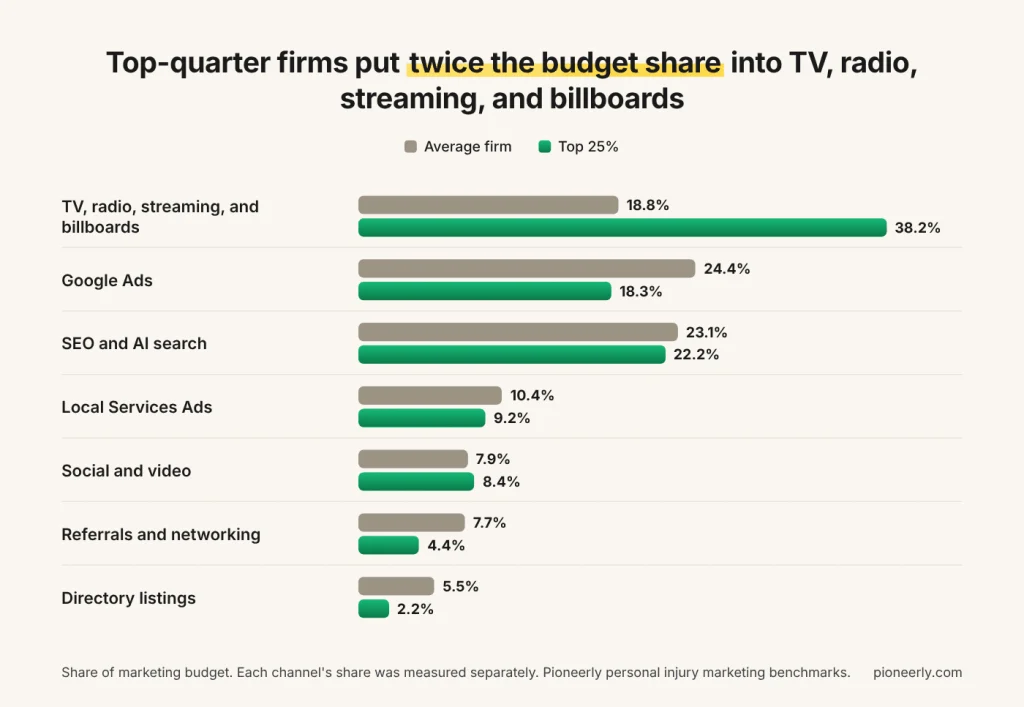
In Pioneerly’s channel comparison, the average share of budget going to TV, radio, streaming, and billboards was 18.8%. For the top quarter it was 38.2%. Those firms also allocated a smaller share to Google Ads (18.3%, compared with 24.4% on average). An established name can bring people directly to your firm. The figures alone can’t tell you whether buying more airtime will do that in your market.
Find out whether you’re ready to buy.
Listen to a sample of calls and look at the cases your firm declined last month. If qualified callers regularly reach voicemail or wait days for a consultation, spend there first. If intake has room and another dollar in paid search is bringing in increasingly expensive cases, you have a reason to test local media.
Choose one message people can remember.
Start with the case type you want and the place you handle it. A firm that focuses on serious truck crashes has something more specific to say than “we fight for you.” Use the same attorney, firm name, and message across the campaign. Before paying to air it, show the spot to someone outside the firm. Ask which firm it was for and when they’d call.
Test the message on video before buying airtime.
Have the attorney who would take the case answer one question on camera. For example, what should a family keep after a commercial truck crash? Try it on the firm’s own channels first. Listen for the questions it prompts and see whether viewers remember the attorney. That can improve the script before you pay to put it in front of a larger audience.
Buy the audience you can actually serve.
Ask a streaming or radio seller how many people in your target counties will see or hear the ad, how often, and at what total cost including production. For a billboard, visit the site and read the design at road speed as a passenger. A cheaper placement outside the counties where you take cases may be the more expensive buy.
Decide how you’ll judge the test before it runs.
Record a baseline for searches for the firm’s name, qualified inquiries, and signed cases in the target counties. Use a dedicated number and ask callers where they first heard of you. If you can, compare the change with a similar county where you didn’t advertise. Then ask a business question: did the extra cases justify production and media costs? A rise in branded searches is an early clue. A few calls without a tracking number can still count if intake documents how they heard about you.
How much should a personal injury firm spend on marketing, and how should it split it?
The average personal injury firm puts 10.7% of revenue into marketing in our data. The top quarter spends 22.0%. To set your own budget, start with how many additional cases your team can handle and what you can afford to pay for each. If you want eight more cases a month and can spend $2,000 to sign each one, that gives you a $16,000 monthly acquisition budget to test. Check that you can carry the expense until fees come in.
Here’s one way an established firm could divide a $20,000 monthly budget. Put $1,000 into intake tools and tracking, $3,000 into LSAs, $3,000 into Google Ads, $4,000 into SEO and AI, $1,600 into social and video, and $1,000 into referrals and networking. That leaves $6,400 uncommitted. If search is already bringing in profitable cases and intake has capacity, some of that money can buy more search. If a local media test makes sense, use the reserve to fund it. There’s no reason to spend the balance just to match a benchmark.
The 12-month plan by market size
If I were taking over an existing PI marketing budget, I’d use the schedule below. In month one, I’d want to know who answers the phone, where signed cases come from, and what they cost. Referrals and work on the Google profile can start immediately. Search ads need a working landing page before the first paid click. The calendar gives you a point to review each investment, and your intake results determine whether it goes ahead.
Table 3. When to start each activity and what to check before expanding it
| Activity | Small market | Mid-size city | Top-20 metro |
|---|---|---|---|
| Intake | Month 1. Test daytime and after-hours coverage. Aim for a live answer and a web reply within five minutes. | Month 1. Compare response times by shift and set up overflow coverage. | Month 1. Test coverage by office, shift, and language. |
| Google profile and reviews | Month 1. Check the listing and ask for reviews at closing. Compare with the nearest three competitors. | Month 1. Review each office separately. Track new reviews and calls monthly. | Month 1. Check visibility around each office for the case types you want. |
| Local Services Ads | Month 1, once calls are covered. Test the case types you want locally. | Month 1. Compare cost per signed case by county before expanding. | Month 1. Start in the counties your intake team can serve reliably. |
| Google Ads | Month 2. Start with one case type and a matching landing page. | Month 2. Give each priority case type its own budget and landing page. | Month 2 or later. Price a test using local bids and the fee you expect to collect. |
| Website | Months 1 to 3. Fix the mobile call button and form before buying clicks. Then add service pages. | Months 1 to 3. Build pages for priority cases and the main cities you serve. | Months 1 to 3. Add office-specific contacts and pages in languages your intake team supports. |
| SEO and AI search | Months 3 to 12. Update directory profiles and measure calls from service pages. | Months 3 to 12. Track visibility and cases by city and case type. | Months 3 to 12. Track Maps and organic search separately. Competitive rankings may take a second year. |
| Referrals | Months 1 to 2. Reconnect with past clients and local lawyers. Record introductions. | Months 1 to 2. Give someone responsibility for follow-up across the firm. | Months 1 to 2. Identify a referral contact in each office. |
| Brand and video | Around month 6. Test attorney videos, then price a small local media buy. | Months 6 to 9. Test one message in a defined service area. | Months 9 to 12. Compare the full cost of a local test with the next increase in search spend. |
| Measurement | From month 1. Record how each signed case found you. | From month 1. Review acquisition costs by channel each month. | From month 1. Break out offices and case types where volume permits. |
A new practice has a different constraint. It needs inquiries while its reviews, referral relationships, and search visibility are still developing. That’s the starting point for our Launch My Practice program. For established firms, our personal injury marketing program pairs the firm with a Growth Counsel who manages the growth strategy and reviews signed cases, costs, and case mix with the partners.
The eight numbers to review every month
Review these eight numbers every month to see what you’re paying to sign cases, how well intake handles inquiries, and which sources bring in clients. Compare them with your previous months and the top-quarter benchmarks below to decide where your firm needs to improve.
- Cost per signed case, by channel. Divide spend by the cases it produced. The top-quarter benchmark across channels is $1,631. Set your own ceiling by market and case type.
- Share of inquiries that sign. The top-quarter benchmark is 21.7%. If your rate falls, separate the people you couldn’t reach from those you reached and declined. Those are different problems.
- Time to first response. Top-quarter firms typically respond in under two minutes. Track the time to a meaningful response to a web inquiry and check nights and weekends separately.
- Share of unanswered calls. Top-quarter firms miss fewer than 4.7%. Look at the hours when calls went unanswered and who was covering the phones.
- New Google reviews by office. The top quarter adds nine or more per month. Compare the pace with your local competitors and check whether your team consistently sends the review invitation.
- Share of signed cases from referrals. The top-quarter benchmark is 55.6%. Show the number of cases alongside the share. The share can fall even as referrals grow if another channel has a strong month.
- Fees collected per marketing dollar. The top-quarter comparison is $9.30 in fees per $1 spent. For PI, compare cases from the same acquisition period and show how many remain open. This month’s settlement checks may come from cases you signed years ago.
- Acquisition cost as a share of the first fee. The top-quarter figure is 8.1%. Compare similar closed matters and use the same definition of acquisition cost each time. A shift from auto cases to complex litigation can change the figure even when a campaign performs as expected.
For a partner-facing report and a way to credit cases that came through more than one channel, see our guide to the eight marketing numbers law firm partners need every month.
Frequently asked questions
What’s the best way to market a personal injury law firm?
Start where prospective clients are dropping out. If a quarter of inquiries go unanswered, fix phone coverage and web follow-up first. If your team answers promptly but too few suitable cases come in, check your Google profile, referral relationships, and LSAs. Add search campaigns for the case types you want when you have a page and an intake team ready for those callers.
How much should a personal injury law firm spend on marketing?
Firms in our benchmarks spent 10.7% of revenue on average and 22.0% in the top quarter. Work backward from the cases you want. A firm that can handle five additional cases a month at $2,000 per signed case has a reason to test a $10,000 acquisition budget, provided it can fund the work until those cases pay.
What does it cost to sign a personal injury case?
The average in our data is $2,956 per signed case, compared with $1,631 for the top quarter. Local ranges are more useful for planning: $958 to $2,397 in a small market, $1,772 to $4,533 in a mid-size city, and $3,756 to $6,995 in a top-20 metro. Compare your cost with the expected fee and the expense of handling that kind of case.
What’s a good cost per lead for a personal injury firm?
Our all-channel average is $290 per inquiry. LSAs average $238, Google Ads $337, and organic search $329. A better test is what those inquiries cost you by the time someone signs. Ten $200 leads that produce one signed case cost the firm $2,000. Five $300 leads that produce one cost $1,500.
Are Google Local Services Ads worth it for personal injury lawyers?
They’re worth testing for firms that can answer calls promptly and accept cases in the advertised area. LSAs had the lowest paid-channel cost per signed case in our data: $1,657 on average and $884 for the top quarter. Review what callers needed, which cases signed, and which charges Google credited automatically. If the same unwanted calls keep coming in, check your service areas and case types.
How many Google reviews does a personal injury firm need to rank in Maps?
There’s no fixed review count that secures a top-three spot. In our mid-size markets, firms in those spots averaged about 140 reviews and a 4.54-star rating. In big cities, the averages were about 550 reviews and 4.18 stars. Look up the firms appearing for your case types near each office, then compare their review count, recency, and rating with yours.
How long does SEO take for a personal injury lawyer?
For “personal injury lawyer [city],” the average time to page one was 12.8 months in a mid-size city and 15.5 to 24.4 months in a top-10 metro. Top-quarter firms reached it in roughly 9 to 10 months. Maps moved faster: 3.4 to 6.4 months to the top three on average. Track both, along with the calls and signed cases each generates.
How fast should a personal injury firm respond to a web inquiry?
Aim to respond within five minutes, including after hours. In our test of 214 firms, 26.5% never answered the web inquiry. Among firms that replied during office hours, the average wait was 15.7 minutes. Test your own process with a form submission after closing and check when someone is available to have a conversation.