



Divorce lawyer SEO helps your firm appear when people search for a divorce lawyer. In 2027, your strategy needs to reflect how clients already search, which is vastly different from what most lawyers think and are used to. Search is no longer just the ten blue links on Google. Someone considering divorce might start with a question on Google and read its AI Overview, an AI-generated summary above the search results. From there, they might open AI Mode, Google’s conversational search tool, to ask about custody, then ask ChatGPT which lawyers have an outstanding track record in their county. Weeks later, usually late at night, they search for “divorce lawyer near me” and call one of the three firms that appear in the map pack, the group of business listings shown beside a map in search results.
Your firm’s visibility throughout that process depends on the same information: your Google Business Profile (your firm’s listing in Google Search and Maps), reviews, directory listings, pages on your website, and what other websites say about you. Modern SEO addresses all of these channels. That’s why, when I work with divorce lawyers as a Growth Counsel at Pioneerly, our SEO strategy includes both answer engine optimization (AEO) and generative engine optimization (GEO). These help your firm appear in direct answers and AI-generated responses on platforms like Google and ChatGPT.
The research behind this approach shows why both traditional and AI search deserve attention. Google’s AI Mode passed one billion monthly users in May 2026. Ahrefs data cited in the 2026 Legal AI Visibility Report puts AI Overviews on 23.6% of legal searches and 57.9% of question-style legal searches. SOCi’s 2026 report found that ChatGPT recommended only 1.2% of local business locations, compared with the 35.9% that appeared in Google’s local pack. Google still determines most hiring decisions, while AI answers determine which firms make the shortlist.
In this article, I draw on my own experience working with divorce lawyers to share what works in practice. These are the nine priorities I recommend across Google Search, Maps, AI Overviews, AI Mode, and AI assistants.
1. Go all in on developing your Google Business Profile and getting as many reviews as possible
Where this matters: traditional Google search results, the Google local pack, AI Mode’s business listings, Gemini, ChatGPT, and Perplexity.
I start with the Google Business Profile because it affects both visibility in search results and whether someone clicks through to your firm. In traditional Google search results, your rating, review count, and what clients say help people decide which firm’s listing to click. The local pack still brings in most clients who search for “divorce lawyer near me,” and your profile provides the information for that listing. AI Mode uses the same rating, review count, hours, and photos in its business listings. It also reads review text for its “what to know” summaries, as Whitespark found in May 2026. In other words, the specific wording in your reviews impacts what AI says about your firm to potential clients. ChatGPT and Perplexity filter businesses by rating before ranking them.
For divorce lawyers, two details deserve particular attention. The first is your primary category, the label in your Google Business Profile that describes your main type of practice. If divorce is your firm’s main focus, I recommend choosing “Divorce lawyer” rather than the broader “Family law attorney” category. It describes your practice more precisely and aligns with what people searching for a divorce lawyer need. Many divorce firms still use the broader category.
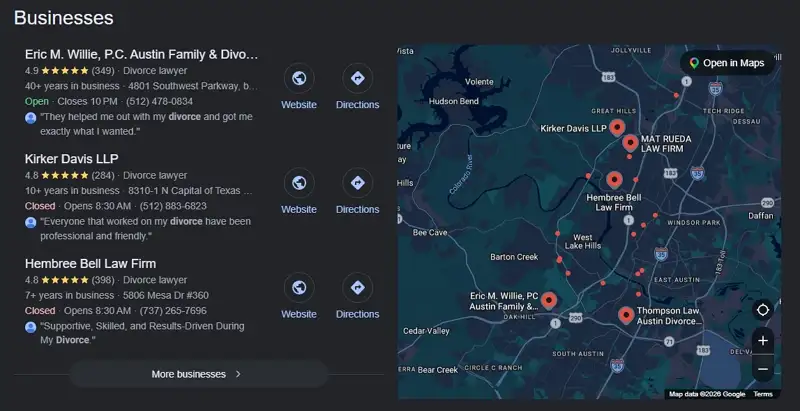
The second is how regularly you get new reviews. Divorce clients leave fewer reviews than injury clients because the matter is private and the outcome is often less straightforward. Pioneerly’s personal injury benchmarks are the nearest published comparison: firms in the Maps top three in a mid-size city have about 140 reviews and a 4.54 rating. The top quarter has 394 reviews and a 4.84 rating. The average firm adds 0.94 reviews a month, while the top quarter adds nine or more. A divorce firm won’t match those injury numbers, but requesting reviews still needs to be a regular part of your process, with a commitment to getting every new review possible.
Here’s the process I recommend to family law firms. Once the matter closes, the attorney who handled it sends a private text or email with a single link to leave a review. While you can’t directly suggest what the client should say, you can improve the chances of the review covering the right things by inviting the client to describe the specifics in their own words, whether the matter involved custody, a high-asset settlement, or an uncontested filing. Those details give AI Mode something to summarize. A client who filed in Sacramento County and mentions the courthouse and custody schedule has written a review that helps your firm across three search tools at once. For my clients, this is a proven way to get higher-quality reviews and influence what AI engines say about their firms. The review uses a first name or an initial, and the firm’s reply thanks the person without confirming they were a client, since confidentiality rules apply here too.
Keep your office and attorney photos current, too. AI Mode shows image galleries, and a profile with two photos from 2019 makes the firm look as though it’s no longer operating. Post regularly on your Google Business Profile as well. You can reuse content from your social media channels, adjusting the wording to give each post a slightly different version for your profile.
2. Create a page on your website for every county where your firm files
Where this matters: Google search results, Google local pack, and AI Mode’s local results.
People who are ready to hire and search for “divorce lawyer near me” and similar phrases still start with Google. StatCounter put Google’s share of U.S. desktop searches at about 94% in March 2026. AI Mode also shows a local pack for those searches. A June 2026 study of 1,120 local searches by Local SEO Data found that AI Mode omitted 28.5% of local pack businesses for the same query, but adding “near me” brought listings back in 38 of 38 cases. For searches about divorce lawyers, AI Mode often showed educational content instead of listings. Your firm needs both a listing and an explainer.
Family law cases are filed by county, so your website should explain how your firm helps clients in each county where you file. Create a page for each county with details specific to that location: the courthouse, required parenting class, filing fee, typical time from filing to decree, and whether the court orders mediation before a hearing. For Cook County, for example, that means the Daley Center, its domestic relations division, and its mandatory parenting program for parents in a custody dispute. Demonstrating your knowledge of each location makes your firm and services relevant to Google, AI assistants, and people searching from those locations. It also helps your firm stand out from divorce attorneys who publish only generic content.
3. List your firm in every relevant legal directory and use the same firm description across all of them
Where this matters: ChatGPT, Perplexity, Claude, AI Overviews, and AI Mode.
When someone asks an AI assistant for a divorce lawyer in a specific location, it draws from a short list of directories before it gets to any firm’s website. The 2026 Legal AI Visibility Report names seven: Chambers, Legal 500, Super Lawyers, Best Lawyers, Martindale, Avvo, and Justia. Martindale-Avvo’s own data identifies Super Lawyers, Avvo, Martindale-Hubbell, and FindLaw as the four legal platforms ChatGPT cites most often.
Pioneerly’s benchmarks show the same pattern. When someone asks an AI assistant for a lawyer, it cites Super Lawyers 29.9% of the time, Justia 22.9%, Google Search and Maps 11.9%, Reddit 7.0%, Avvo 4.3%, and YouTube 4.3%. Across all legal answers, 78.2% point to a directory first. Google’s AI results also rely heavily on Yelp and Facebook, according to Peec AI’s analysis of 30 million sources.
Build a better case acquisition system for your law firm.
Tell us about your firm and your goals. We’ll give you our honest take on how to get there.
Start with a complete attorney profile on Avvo, Justia, Super Lawyers, FindLaw, and Martindale. Include “divorce” in the practice description, and use the same firm name, address, phone number, and attorney list on each. Fellows of the American Academy of Matrimonial Lawyers should also be listed in its directory, since that credential identifies a divorce specialist.
Then check that the details match. Most firms skip this step. Business location data on ChatGPT and Perplexity was only about 68% accurate in SOCi’s 2026 report. When an assistant finds two phone numbers and three versions of your firm’s name, it uses the directory’s version, even if it’s five years old. That’s why I recommend creating a dated firm fact sheet: one document containing your firm’s name, description, offices, phone number, practice areas, attorneys, and fee model. Use it as the reference for every listing. You’d be surprised how much you can gain by keeping to the same exact wording across all of your directory listings.
4. Publish website pages about divorce costs and timelines and what clients will pay or receive in support
Where this matters: Google’s unpaid search results, AI Mode, and ChatGPT.
When I help a divorce firm decide which content to publish, I look at the questions clients ask before they’re ready to book the first consultation. Sterling Sky reports that child support and spousal support calculators were divorce firms’ top source of organic traffic, meaning visitors from unpaid search results, and that those pages get visitors to take the next step. The same practical content matters in AI search. Semrush found that AI Mode wrote answers about twice as long for questions about choosing or paying for a service as for general informational questions, giving firms with published figures more room to appear. Aleyda Solis’s checklist also prioritizes pricing, comparisons, and calculators over general articles because they help people make decisions.
The search patterns I see in my work with family law clients help me decide which pages to build first. The typical client searches for about 12 weeks before booking. They start with a question in week one, such as “can I get divorced if my husband won’t agree,” ask about custody in week four, and search “how much does a divorce cost in Boise” in week nine. By week 12, they’re searching “divorce lawyer near me.” A cost page reaches that client three weeks before a competitor’s profile does.
| Page that helps clients decide | What people search for | Why to prioritize it |
| Cost of a divorce in your state, with retainer ranges and hourly rates | “how much does a divorce cost in [state]” | In Pioneerly’s client work, high-asset divorce averages about $60,000 in fees and contested divorce about $22,000. The page qualifies the client before the call. |
| Child support and spousal support estimators using the state’s formula | “[state] child support calculator” | Top organic traffic source for divorce firms, per Sterling Sky |
| Uncontested and contested divorce timelines by county | “how long does a divorce take in [county]” | The second question asked in every consultation |
| How to choose a divorce lawyer, with clear criteria | “best divorce lawyer in [city]” | ChatGPT uses explicit criteria to rank options |
| Uncontested divorce, with the flat fee stated | “uncontested divorce cost [state]” | About $3,500 flat in Pioneerly’s client work. It gives a direct answer, but I deliberately give this page a lower priority. |
Source: Pioneerly’s family law client work; Sterling Sky
Publishing a range gives the AI assistant a figure it can quote. Without one, your page gets passed over for a page that includes numbers.
Keep these explainers separate from your booking pages, and link each one to the relevant booking page with a clear next step. The explainers earn citations and send readers to the booking pages that bring in consultations.
If your firm publishes a retainer range, you’ve answered a question that nine other firms make the client call to ask.
5. Earn backlinks from relevant websites Google and Bing already trust
Where this matters: Google’s unpaid search results, the Google local pack, Bing and, through it, ChatGPT and Copilot. Rankings also affect AI Overviews and AI Mode.
Despite all of the new factors influencing rankings in Google and AI assistants these days, backlinks remain one of the most effective ways to strengthen your firm’s authority and improve its visibility in search. On average, the #1 result in Google has about 3.8 times as many backlinks as websites in positions two to ten, according to Backlinko’s analysis of 11.8 million search results. Across a million keywords, referring domains, meaning the separate websites linking to yours, correlate with rankings at about 0.26 in Ahrefs’ data, one of the fifteen studies BuzzStream compiled on the question. In Whitespark’s 2026 Local Search Ranking Factors, the quality of links pointing to a website ranks third among all local organic factors.
Those rankings still determine which pages make it into the results AI answers draw from. The top ten accounts for 38% of AI Overview citations, and most of the rest come from positions 11 to 100. AI Mode shares 51% of its cited websites with the top ten, according to Semrush, while ChatGPT reads Bing’s top 20 to 30 results, as Damian Rollison showed in Search Engine Land. First-page rankings correlate at about 0.65 with being mentioned by ChatGPT, compared with a correlation of just 0.10 between raw backlink counts and citations, in Seer Interactive’s data from the same BuzzStream roundup. Links help your pages rank, and those rankings help them earn citations.
For a divorce firm, these are the links worth pursuing:
- Local news stories that quote an attorney when the state changes its alimony law, passes a pet custody statute, or reports on gray divorce. Florida ended permanent alimony in 2023, for example, and New York passed a pet custody statute in 2021. The quote links to the relevant explainer from point 6.
- The state and county bar association’s member and section pages, CLE speaking pages, and law school alumni and adjunct faculty pages.
- Local organizations the firm supports: family service nonprofits, domestic violence shelters, parenting programs, and youth sports.
- Guest articles in the state bar journal, the ABA Family Law Section, and the local legal newspaper.
- Social media content that gets shared and talked about across platforms. Publish your attorneys’ insights on divorce issues, answer common client questions, and give people a reason to reference your firm. Those conversations can generate links and brand mentions, including mentions without a link, that help build your firm’s visibility and authority in search.
One link from a local newspaper or state bar counts for more than fifty generic directory links.
Avoid paid links from irrelevant websites, private blog networks created to link between websites and influence rankings, reciprocal link swaps unless they’re with other lawyers or relevant associations, and scholarship pages created solely to get links.
6. Give each client question a self-contained answer on every website page
Where this matters: AI Overviews, AI Mode, and ChatGPT.
AI assistants such as ChatGPT or Gemini break a search question into several related searches, a process called query fan-out. They then assemble an answer from individual passages rather than whole pages. Because of this, a high position in Google search results doesn’t automatically guarantee that your page will be cited in an AI answer. Ahrefs found that about 38% of AI Overview citations came from pages in Google’s top 10 in March 2026, down from about 76% in mid-2025. Semrush found that AI Mode shared only 32% of its cited web addresses (URLs) with the top 10.
For “divorce lawyer in Denver,” those questions cover Colorado’s residency requirement (91 days), the waiting period before a decree (91 days from service), how marital property is divided (equitable distribution), how child support is calculated (the income shares model), what a divorce costs, the difference between contested and uncontested divorce, and whether mediation is required. A Denver firm’s divorce page is eligible for each of those searches if it covers each question in a separate section, uses the client’s language, and names the statute. A single 900-word essay about “compassionate representation” isn’t eligible for any of them.
Mike King at iPullRank puts it plainly: each section needs to make sense when read on its own. I also recommend descriptive headings, a direct answer in the first two sentences, specific names for people, places, and organizations, explicit criteria, and tables that readers can understand without the surrounding text.
The page’s URL matters, too. The slug is the part of that address that names the page. In Ahrefs’ study of 1.4 million ChatGPT prompts, ChatGPT cited pages with slugs written in ordinary words 89.8% of the time, compared with 81.1% for pages without them. Use a URL such as /colorado-divorce-residency-requirement/ and a title that matches the question.
This part of good SEO gets complicated and technical pretty quickly, and there’s a lot of nuance to it. That’s why at Pioneerly, our SEO plan for divorce attorneys covers everything from traditional organic optimization to AI search optimization. AI search evolves very quickly and the rules and strategies that work change all the time. We stay on top of it and make sure our clients receive the most effective support across all domains of SEO. The results speak for themselves – Pioneerly clients on average grow over 2x faster than their competitors.
7. Make sure your website meets AI crawler requirements and is indexed by Bing
Where this matters: ChatGPT, Perplexity, Claude, and Copilot.
For your firm’s website to appear in AI answers, AI tools need to be able to find and read its pages. That means checking two things: whether your pages are indexed by search engines these tools use, including Bing, and whether your website allows AI crawlers, the automated programs that read your content, to access them. Google’s rankings alone don’t tell you either. In Ahrefs’ study of 1.4 million prompts, 88% of ChatGPT’s cited URLs came from web search, which is why these checks deserve attention even if your firm already ranks well on Google.
This problem is more common than you’d expect. Cloudflare, a service used to protect websites and help them load quickly, has blocked AI crawlers by default since July 2025, and many law firm websites use Cloudflare without changing that setting. Often, the web agency hasn’t mentioned it because nobody has asked.
Here’s what to check:
- Open yourdomain.com/robots.txt in a browser, replacing yourdomain.com with your firm’s website address. This file gives crawlers instructions about which pages they can access. Look for “User-agent: GPTBot”, “User-agent: OAI-SearchBot”, “User-agent: ClaudeBot”, or “User-agent: PerplexityBot”, followed by “Disallow: /”. The User-agent line names the crawler; Disallow: / tells it not to access the website. Any of those combinations means the crawler is blocked. Ask whoever manages your website to remove the blocking line.
- If your website uses Cloudflare, log in, select the website, and go to Security, then Bots. Find the AI bots setting. It should be off or have an allow rule for the four crawlers above.
- Search “site:yourdomain.com” on Bing and compare the number of results with the same search on Google. If Bing shows only a fraction of them, set up Bing Webmaster Tools, Bing’s dashboard for monitoring your website in search. It can import your website from Google Search Console, Google’s equivalent dashboard, in one click. Submit your sitemap, a file listing your website’s pages, and turn on IndexNow, which notifies search engines when pages change. Both Yoast SEO Premium and Rank Math, tools used to manage website SEO, support it.
You can avoid two unnecessary tasks here. AI Overviews and AI Mode use Googlebot, Google’s standard website crawler, so a firm that’s indexed in Google is already eligible for both. The Google-Extended setting, a separate control for Google’s AI use of website content, only affects Gemini. You can also skip llms.txt, a proposed file for guiding AI tools to a website’s content: SE Ranking found no measurable effect on citations across 300,000 websites, and Google has said it doesn’t use the file.
While you’re checking, make sure fees, office addresses, and attorney names appear in the page’s HTML, the underlying code that contains its content. If JavaScript, code that runs on the page, loads those details only after the page opens, most AI crawlers see an empty page.
At Pioneerly, we handle these technical details for you, checking that search engines and AI tools can find and read your firm’s content. Your team’s time is better spent sharing the expertise that makes that content worth finding.
8. Make each attorney’s credentials easy to verify online
Where this matters: AI Mode, ChatGPT, and Google.
Google checks that the author of a divorce page is a real lawyer with credentials, and AI systems use the same information to recommend individual attorneys as well as firms. The 2026 Legal AI Visibility Report advises firms to prepare partners’ LinkedIn profiles as sources AI can cite within 90 days. In Contently’s compilation of Peec AI, Semrush, and Profound data, LinkedIn was the most-cited website in AI Mode and the third most-cited on ChatGPT.
Most of this is straightforward profile work that firms haven’t completed:
- Give every attorney a full bio page, using the same name, photo, and title as their other profiles. Ask your website team to add Person schema, code that labels information about the attorney for search engines. Its sameAs field connects that person to their complete LinkedIn profile, Avvo profile, state bar record, and Super Lawyers listing.
- State board certification in family law where the state offers it, including Texas, Florida, California, North Carolina, Arizona, and New Jersey. Include fellowship in the American Academy of Matrimonial Lawyers, too. Use the same wording for both credentials on the bio and LinkedIn.
- Describe the attorney’s years in family court, the counties they practice in, and the kinds of matters they handle. Use facts rather than adjectives.
- Put the responsible attorney’s byline on every article and FAQ page, with a link to their bio.
If an AI system can’t verify an attorney at your firm, it can’t name your firm in its answer.
9. Earn mentions on social platforms and in local news
Where this matters: AI Overviews, AI Mode, ChatGPT, and Perplexity.
Mentions, references to your firm on other websites whether or not they include a link, are a stronger predictor of AI Overview visibility than backlinks. In Ahrefs’ analysis of 75,000 brands, web mentions of a brand correlated with AI Overview visibility at 0.66, compared with 0.22 for backlinks. In its March 2026 research, Ahrefs identified YouTube as the most-cited website in AI Overviews and the strongest single correlate of AI Overview brand visibility. Reddit appeared in every platform’s top five. Semrush found Reddit, YouTube, and Facebook in 68% of AI Mode results that included links. Peec AI found that ChatGPT favored Wikipedia and editorial sources, while Google’s AI results favored social and review platforms.
For a divorce firm, focus on these four channels:
- Short YouTube videos answering the related questions from point 6. Cover one question per video, with the attorney saying both the question and the answer aloud. AI reads the transcript.
- Local news stories that quote the attorney on alimony reform, pet custody, gray divorce, or cryptocurrency in property division. When a Tulsa newspaper covers a change to Oklahoma’s waiting period, the firm that answered the reporter’s call gets cited in the next AI answer. These are the same stories that earn links in point 5. A mention with a link contributes to both.
- Bar association pages, community sponsorships, and local organization websites.
- Answers in Reddit threads such as r/Divorce. Keep them to general information: bar rules on solicitation apply, and threads that read like advertising get removed anyway.
An attorney’s LinkedIn posts also support the profile work in point 8.
How I would put these recommendations into practice
I’ve mixed traditional SEO and AI search throughout this list because a divorce lawyer needs both. I start with the Google Business Profile and county pages to reach people looking for a lawyer locally, then work through the directories, content, and links that support visibility across search tools. The order gives you a place to start, but some checks can happen alongside the larger website projects.
Your profile and reviews, directory listings, and crawler access are inexpensive to address, and problems with them can rule your firm out entirely. A firm with a 3.8 rating, no Avvo profile, and Cloudflare blocking GPTBot can’t be recommended, whatever its website says. Profiles and reviews affect the most search tools and determine the shortlist on all of them. Directories supply the answers to ChatGPT-style questions. Most firms already allow crawler access, but those that don’t lose the benefit of the rest of the work. I’d check access early, even though I’ve explained it later in the list.
For website content, county pages serve Google and AI Mode’s local results, where clients who are ready to hire still search. Decision pages are the strongest commercial pages across Google, AI Mode, and ChatGPT, and your firm’s own fee figures can’t be copied. Sections that answer related questions serve all three AI search tools as well as Google. I’d plan these pages together so local coverage and useful answers support each other.
Backlinks, verifiable attorney profiles, and mentions build your firm’s reputation outside its website and have the strongest correlations in the research. Backlinks improve Google and Bing rankings, which still feed every AI search tool. Attorney profiles are quick to complete and give AI systems the information they need to recommend individuals. Mentions have the highest correlation of anything measured, but they’re also the least controllable. Links and mentions take longer to produce cumulative results than website changes, so I’d work on them alongside the website rather than wait for every page to be finised.
What a Divorce Lawyer Shouldn’t Do to Improve Their SEO
1. Avoid bought fake or incentivized reviews and wait until the case is over to ask
The FTC’s rule on fake reviews has been in force since October 2024, with civil penalties above $50,000 per violation. Google filters sudden bursts of reviews and removes profiles it flags, while bar advertising rules treat reviews as testimonials. Every AI search tool filters by reviews first, so a flagged profile removes your firm from all of those answers at once. There’s also the client to consider: someone in the middle of a custody dispute is already under stress. Send the request after the decree.
2. Avoid mass-produced county pages and hundreds of AI-written articles
Google’s scaled content abuse policy, in force since March 2024, targets mass-produced pages, including county templates with only the name changed. AI Mode skips pages with no location-specific information. ChatGPT’s cited pages had a median age of about 500 days in the Ahrefs prompt study, so citations go to specific, evergreen content. Ten county pages that name the courthouse, parenting class, and filing fee perform better than two hundred pages with only the county name changed.
3. Avoid hidden text embedded instructions manufactured Reddit threads and fabricated citations
Google expanded its spam policies in May 2026 to cover attempts to manipulate AI results. Aleyda Solis’s checklist identifies tactics that backfire: prompt injection, where instructions hidden in content try to influence an AI answer; fabricated reviews; manufactured community activity; and citation gaming, or attempts to manipulate which sources AI cites. For a licensed attorney, the consequences can include bar action. There’s no benefit to justify that risk: these systems reward the same things a careful reader values.
Get Expert Help With Your Divorce Firm’s SEO
At Pioneerly, we help divorce firms put all of this into practice, from local visibility and content to AI search and the technical details. Our family law marketing program brings that work together to help your firm attract and sign the right clients. We work with one family law firm per location. Reach out to discuss how we can help your firm grow.