



Ask ChatGPT to recommend a lawyer for the cases your law firm wants, in the city or county where you practice. Read the answer, then look at the sources. Which firms appear? What does it say about them? Where did that information come from?
If your competitors keep showing up and you don’t, you have a specific marketing problem to investigate. I’ve been fortunate to dissect this problem for law firms since the very beginning of AI search, and from my own experience, I can tell you this: the solution is almost never rocket science.
Sometimes the competing firms have hundreds of recent reviews while your last one arrived weeks or months ago. Sometimes the directories AI keeps consulting barely describe your practice. Sometimes your website has only four short paragraphs to explain what you do, and you’re not being consistent or using the right language when describing your firm.
Generative engine optimization, or GEO, is the work of getting your firm and its content represented in AI-generated answers. Answer engine optimization, or AEO, focuses on making your information easy to find and use as a direct answer. For any law firm, these two overlap: you want to appear when someone asks a legal question, and you want to be considered when that person asks whom to hire.
I work with some of the fastest-growing law firms in America and help them with AI search optimization. In this article, I’m going to give you strategies and tactics that are proven to work and form the foundation of a good GEO & AEO strategy for your firm.
1. Build the right type of reviews where AI looks for them
Client reviews are absolutely crucial in the AI era of search. Not just having them, but getting them consistently, across all relevant platforms, and phrased in a way that helps your law firm be better understood by AI.
With that in mind, when was the last time you looked at your firm’s reviews outside Google?
In Optimize My Firm’s October 2026 study, researchers collected 3,000 ChatGPT answers across 100 U.S. cities using personal injury prompts. Of the searches ChatGPT ran, 79% included “reviews” and 70% included “best.” The engine actively looked for evidence of reputation, even when the person asking hadn’t used those words.
Among Google Maps firms studied, ChatGPT named 52% of those with at least 1,000 reviews, compared with 4% of those with fewer than 50. Its most-recommended firm was outside the Maps top 20 in 37% of cities.
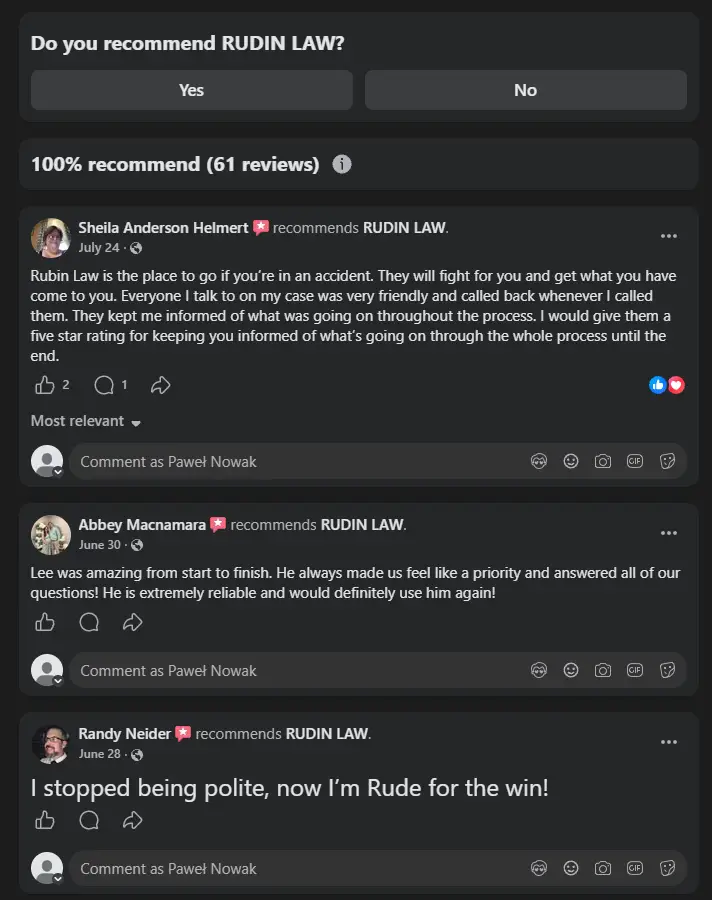
I see the same patterns in my own GEO campaigns for the law firms I work with. Firms that rank well in Google Maps aren’t necessarily the ones AI recommends. You need to look beyond your Maps position and examine the reviews AI finds when researching your firm: how many there are, how recent they are, and what they tell a prospective client about your practice.
Whitespark’s research into Bing Places review sources found Facebook and Yelp leading across the local businesses it examined. Look at your own category and city. Open your Bing listing and several competing listings, and record which review platforms supply the ratings. You’re probably surprised I’m even mentioning Bing and not just Google, but there’s an important reason behind that. I’ll cover it in detail in tactic #3 below.
Make review collection someone’s responsibility. Decide when clients should receive a request, who sends it, how you ask for it, and how you’ll monitor participation. Ask for honest feedback through platforms that permit review requests. AI reads the content of your reviews, and while it’s against the rules to suggest to your clients what they should say in their review, you can still strategically mention some things that went well or that are important to your firm within the request.
Here’s a useful research exercise: ask ChatGPT, with search enabled, “Who are the best [practice area] lawyers in [city]?” Inspect the search activity where the interface exposes it. Record the phrases and sources that recur across several runs, then search those phrases in Bing yourself. You now have a concrete list of reputation searches to investigate.
2. Get listed in the legal directories AI likes to cite
Your law firm may have a beautiful website and still be missing from the pages an AI engine uses to choose lawyers.
In the same Optimize My Firm study I mentioned earlier, directories accounted for 43% of citations. Avvo appeared in 70% of answers and Expertise.com in 63%, followed by Super Lawyers at 15% and Justia at 13%. A recommended firm’s own website appeared in only 27% of answers.
From my own experience, I can say that legal directories are AI’s favorite source for the most generic and high-level queries. The more specific the question a user asks, the less you see legal directories in the sources for the answer.
Different engines draw on different sources. In Firesign’s law firm recommendation case study, Perplexity cited Super Lawyers in 50.7% of answers, Best Lawyers in 45.2%, and Chambers in 38.4%.
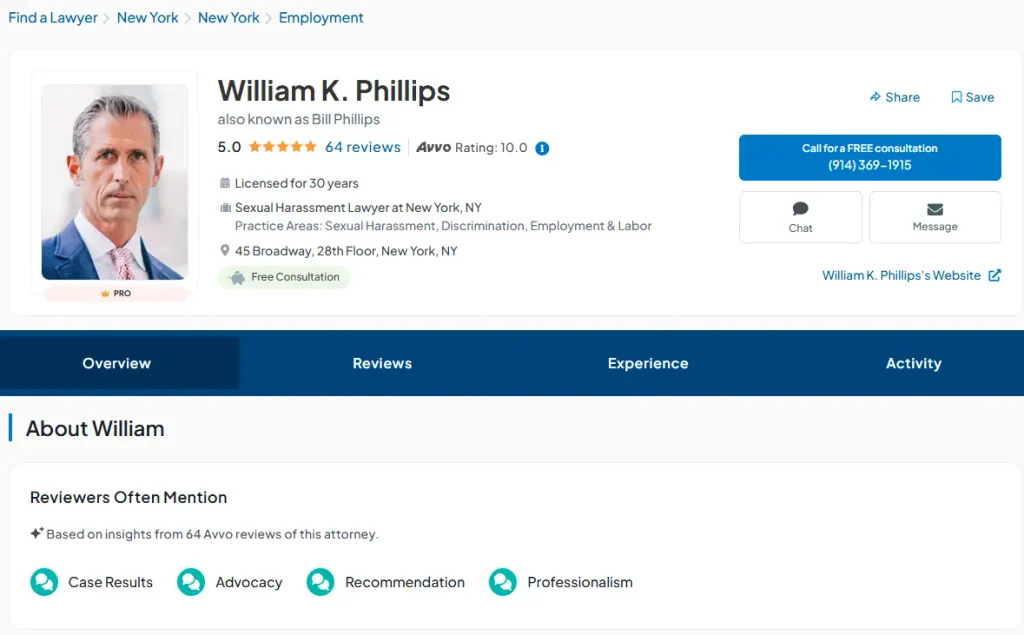
Start with three or four sources that keep appearing for your practice and location. Check whether your firm is included, whether the profile accurately describes the work you want, and what the publisher requires for inclusion. In some cases, additional features for your listing in a given directory are worth the cost of the premium plan – which was almost never the case before AI.
Peec AI’s analysis of nearly 200,000 responses found that placement within cited lists mattered, with particularly strong patterns on ChatGPT and Copilot. The practical implication of this is straightforward: improve your presence on the pages the engine repeatedly retrieves before paying for dozens of listings nobody has seen it use.
Be careful what you count as success. Being cited is not the same as being chosen. You need to distinguish a link to your website from a recommendation of your firm. If an answer cites your article but tells the reader to hire someone else, those are two very different outcomes. Sometimes getting cited is pretty easy, while getting recommended takes months of complex technical work.
3. Fix Bing indexing and AI crawler access for your law firm
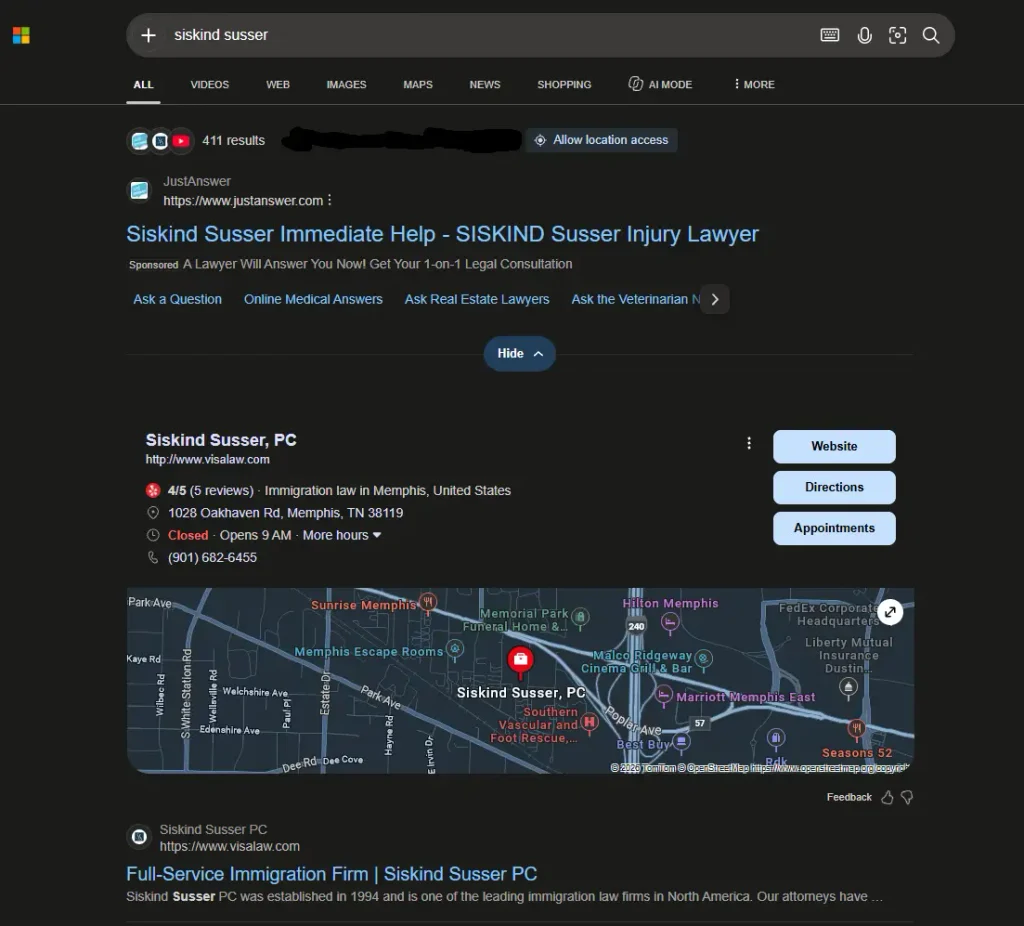
ChatGPT uses Bing’s web index as one of its sources when searching the web. If your law firm’s website is missing from that index, or Bing can’t access your important practice pages, you’re making it harder for ChatGPT to find and show your content to potential clients.
In Seer Interactive’s February 2025 study, more than 87% of SearchGPT citations matched Bing’s top 20 organic results for the same questions. That’s a good reason to give Bing more attention in your firm’s search strategy. Yes, in the growing world of AI search, it’s no longer just about Google.
Start by asking whoever manages your website to show you Bing Webmaster Tools. Are your important practice pages indexed? Are there crawl errors? Is the sitemap current? How is your website performing on Bing overall?
In my capacity as a fractional law firm CMO, I always take these practical steps to make sure our visibility in Bing is covered:
- Verify the website in Bing Webmaster Tools and inspect your priority pages.
- Resolve crawl errors, accidental indexing restrictions, and broken internal links.
- Submit an accurate sitemap and claim or update your Bing Places listing.
- Enable IndexNow to notify participating search engines when pages are added, changed, or removed.
- Check robots.txt and your security settings for blocks affecting search crawlers.
Be specific about that last item. OpenAI distinguishes its search and training crawlers: OAI-SearchBot serves ChatGPT search; GPTBot serves model training. Allowing one is a separate decision from allowing the other. Have your developer check the relevant search crawlers for each platform you want to reach, including Perplexity and Claude. My take on this is simple – allow all of the major AI search crawlers. There’s no good reason not to.
Also ask your website developer to inspect the page’s original HTML. Your practice description, location, attorney information, and main answers should be present there. Ahrefs identifies JavaScript-dependent content as an AI discoverability issue because most AI bots can’t execute it. A page that looks complete in your browser can still give a crawler very little to read.
4. Use query fan-out to plan your law firm’s GEO content
Consider this question: “Do I have a case after a rear-end collision in Houston if I didn’t go to the hospital right away?”
There are several questions inside it. Who was at fault? What evidence matters? How does delayed treatment affect the claim? What deadlines apply? Which local lawyers handle this situation?
AI search can expand a starting prompt that the user provided into related searches, a process called query fan-out. iPullRank’s practical guide to query fan-out shows how to map those searches and examine the content formats that answer them. This gives you a better brief than “write 1,500 words about Houston car accident lawyers.”
Start with one case type your firm wants more of. Take a question your intake team hears regularly and map the follow-up questions a prospective client needs answered. Use a tool such as Qforia, or have your team build the map manually and test the questions across AI search engines.
Build a better case acquisition system for your law firm.
Tell us about your firm and your goals. We’ll give you our honest take on how to get there.
For each question, inspect the cited sources. A question about documents may call for a checklist. A question about the process may need a timeline. A comparison may work best as a table. Give each answer the format that makes it easiest to understand, then decide which answers belong together on a page.
Your existing search data can help. We’re getting into technical things here, but I use a regular expression to find queries containing ten or more words. In the Performance report in Google Search Console, add a Query filter, select Custom regex, and enter:
^(?:\S+\s+){9,}\S+$
Export the results and group them by the client’s situation: cost concerns, evidence, deadlines, eligibility, or choosing counsel. These queries give you language people already use when looking for answers. Add the questions from consultation notes and intake calls, with identifying details removed.
Now your AEO content plan reflects actual client concerns. An attorney can review the legal substance while your content team makes the answers clear, specific, and easy to navigate.
5. Put clear answers to the clients’ questions near the top of your law firm website
Open your homepage and read only the first few paragraphs. Would a stranger know what kind of firm you are, where you practice, and which cases you handle?
Let me be straight – “We’re fighting for you” and similar slogans don’t answer any of those questions.
In the Optimize My Firm research, 79% of citations to recommended firms’ websites went to their homepages. Give that page a plain description someone can understand immediately. For example, a firm might say:
“Harbor Family Law is a Chicago law firm representing parents and spouses in divorce, child custody, and support matters in Cook County.”
That sentence tells both the reader and the search engine something useful. Follow it with relevant details about the attorneys, the firm’s approach, and how to arrange a consultation.

Apply the same discipline to practice pages and articles. Kevin Indig’s research into how AI selects passages found that 44.2% of citations came from the first 30% of a page. Cited passages were nearly twice as likely to contain clear definitions. Among citations associated with questions, 78.4% of those questions appeared in headings.
Put the main answer early. Use a descriptive question heading, then answer it in two to five sentences or a short list before expanding. Someone asking what to bring to a consultation should see the documents they need before reading a long introduction to the firm’s history.
Name the relevant court, jurisdiction, procedure, or service where it helps explain the answer. In my own research, I also found a high concentration of proper nouns in frequently cited text. The useful lesson is specificity: “file with the appropriate authority” tells a reader much less than naming the relevant office and explaining its role.
This is an editing assignment as much as a writing assignment. You may get more value from moving one useful answer up the page than from adding another thousand words below it.
6. Refresh content on your firm’s website that already earns AI citations
Before commissioning another batch of articles, find out which existing pages on your website AI engines already use.
Seer Interactive’s July 2026 recency study examined 47,097 citations across ChatGPT, Gemini, and Perplexity. Measured by the latest publication or update date, 75% of cited pages were less than a year old and 88% were less than two years old. Measured by original publication alone, only 42% were under a year old.
A substantial share of the fresh material came from maintaining existing pages. That deserves a line in your content budget.
Build a list of practice pages, guides, and FAQs that already receive citations for your priority questions. Assign each an attorney reviewer and record what needs checking. Useful triggers include a change in the firm’s fees, a revised court procedure, new filing requirements, a statutory amendment, or an outdated explanation of the consultation process.
Update the substance, show a visible “Last updated” date, and use IndexNow to notify participating search engines of the change. Keep the existing address when the page continues to serve the same purpose.
I’d also look for answers that are technically current but unhelpful. Does the page tell readers what to do next? Does it explain the documents they need? Does it answer the follow-up question your intake team hears every week?
Give the strongest existing pages proper maintenance before expanding a library nobody has time to review.
7. Build a consistent identity for your law firm across AI search sources
What is the one sentence you want AI to say about your firm?
Write it down. Include the firm’s name, practice focus, location, mission, and relevant case types. Then compare it with your homepage, directory profiles, association listings, speaker biographies, and press coverage.
You may find five different versions of your own practice. One profile reflects an office you closed. Another emphasizes work you no longer want. A third describes every legal service imaginable. Those inconsistencies make it harder for someone researching the firm to understand whether you’re the right fit.
In Ahrefs’ study of 75,000 brands, branded web mentions had a 0.664 correlation with AI Overview visibility, compared with 0.218 for backlinks. The broader description of your firm across the web deserves deliberate attention.
Jason Barnard’s entity-home approach starts with a definitive source of information about a business. For your firm, establish that description on your own website, then carry the same facts into the places that describe you: state bar profiles where available, legal directories, professional associations, event biographies, and media materials. Keep the facts consistent even when the wording changes to fit the publication.
Give people a reason to mention you, too. Original research is particularly useful here, and we publish a lot of it at Pioneerly. We’ve recently published a report on legal deserts in America, and we also maintain our own personal injury marketing benchmarks. A personal injury law firm could analyze public crash records for its county. An employment firm could examine local enforcement data. Publish the findings, explain the method, and make the useful figures easy to cite.
The original GEO research paper tested methods including statistics, quotations, and source citations, reporting visibility improvements of up to 40% in its experimental setting. For a law firm, the practical opportunity is to contribute information other people can use in their own reporting and explanations.
That’s the approach behind Pioneerly’s Legal Deserts in America research, which brings together county-level data on legal practices and indicators of legal need. The resource gives journalists, researchers, and legal organizations specific findings to discuss and cite.
Distribute substantive findings through relevant associations, local media, and your own channels. For a meaningful research release or firm announcement, newswire distribution can add another accessible source. Firesign’s study found Google AI Overviews drawing on releases carried by PR Newswire and EIN Presswire.
Keep every description factual. Use the actual award, the actual location, and the work your firm actually handles. A consistent identity is much easier to maintain when nobody has to defend an invented superlative.
Bonus Tip: Use YouTube to answer prospective clients on video
If your firm can make useful videos consistently, YouTube deserves a place in your GEO and AEO plan.
Ahrefs’ December 2025 brand visibility study found that YouTube mentions had the strongest correlation with AI visibility among the factors examined, at approximately 0.737. Its research also placed YouTube among the leading cited domains across Google’s AI search products.
Let me be clear here. This is not about production value. You don’t need a fancy studio or a podcast setup. All you need is a phone, a good mic, and helpful things to say.
Start with questions your lawyers can answer clearly: what happens at the first consultation, which records to bring, or how the firm handles a particular type of matter. Put the question in the title, answer it promptly, and identify the attorney, firm, and relevant jurisdiction.
Use accurate captions and a useful description. Turn suitable excerpts into Shorts and link related videos from the relevant practice pages. An appearance on a local organization’s or professional association’s channel also gives someone else an opportunity to introduce your firm.
I’d add this after the basic review, directory, and website work has an owner. Video requires attorney time, editing, and a publishing routine. Choose a schedule the firm can sustain and topics that support the cases you want.
Law firm GEO mistakes to avoid in 2027
There are plenty of small technical tasks you can package as an AI strategy. Be selective about which ones receive your time and budget.
Making llms.txt a priority. Google’s guidance on optimizing for generative AI search says Google Search doesn’t use these special AI text files. Ask your team to fix access, indexing, and unclear content before spending time on one.
Breaking pages into tiny pieces for machines. The same Google guide says there is no requirement to “chunk” content for AI. Use headings and concise answers because they help people find information. Keep explanations together when readers need the context to understand them.
Publishing your own best-lawyers list and placing yourself first. In Lily Ray’s analysis of B2B software recommendations, Google AI Overviews excluded the publishing brand from their recommendations in 69% of cases where they cited its self-promotional list. Your firm has better material to publish than an award it has given itself.
Put your law firm GEO strategy to work
Start with one practice area, one market, and a set of questions that reflect the cases you want. Repeat those questions across the relevant AI tools, record the firms and sources that appear, and use the gaps to assign work.
Someone should own reviews. Someone should maintain the profiles that matter. Your website team should resolve access problems, and your attorneys should help improve the answers prospective clients need. Give each assignment a deadline and review the results together.
Track recommendations, cited pages, and the accuracy of the firm’s description. Then follow the business outcome: relevant inquiries, consultations, and signed matters. Ask new callers how they found you and which sources influenced their decision. That connects AI visibility to the practice you’re trying to build.
If you want help turning this into a focused plan for your firm, talk to Pioneerly. We’ll look at the cases you want, how prospective clients find and evaluate firms in your market, and where your current presence needs work.