



As hard as it is to believe, a county with more than half a million residents can still qualify as a legal desert in 2026. Pinal County, Arizona, grew by 25.4% between 2020 and 2025, yet Pioneerly’s analysis puts it at just 3.7 legal practices per 10,000 residents, compared with a national average of 12.9.
It’s one of the findings in “Legal Deserts in America,” research we’ve published at Pioneerly covering all 3,144 U.S. counties and county equivalents. Through an interactive map, downloadable data, and analysis, Pioneerly examined where legal practices are concentrated, where they’re scarce, and how that compares with indicators of legal need.
What stands out to me is how different these places are. Some are growing quickly. Others have older populations, high poverty rates, or barely any practices based locally. Understanding those differences matters both for improving access to legal help and for firms deciding where they can build a sustainable practice.
Key Insights
- Pioneerly published “Legal Deserts in America,” covering all 3,144 U.S. counties and county equivalents. The research combines an interactive map, downloadable data, and analysis of legal practice availability and legal need.
- Two-thirds of the counties classified as legal deserts gained residents. Population increased in 203 of the 305 counties between 2020 and 2025.
- Legal deserts include counties with hundreds of thousands of residents. Eight have more than 100,000 residents, including Pinal County, Arizona, with over half a million.
- 71.4 million Americans live in legal desert or underserved counties. That’s more than one in five people living in counties with fewer than 7 legal practices per 10,000 residents.
- Statewide lawyer counts can hide gaps in local legal services. Minnesota has 44.7 resident active attorneys per 10,000 people statewide, yet half its population lives in counties with fewer than 7 legal practices per 10,000.
Legal deserts exist in growing counties with hundreds of thousands of residents
Of the 305 counties Pioneerly classified as legal deserts in 2026, 203 gained population between July 2020 and July 2025. That’s 66.6%. This means that the issue of access to legal representation is broader than small towns losing residents and struggling to replace retiring lawyers.
Pinal County is the largest legal desert in Pioneerly’s dataset. Merced County, California, comes next, with 297,260 residents and 3.6 practices per 10,000. Eight legal desert counties have more than 100,000 residents. Together, they’re home to 1.58 million people.
I advise law firms on growth and marketing, and I’m not a journalist, so I’ll leave the social analysis aspect to the experts and focus on my domain instead. And for me, the report gave us a reason to revisit the assumptions behind a market shortlist for firms looking to expand geographically. A place with relatively few practices may have a substantial and growing population. Before dismissing it as a dying market, I’d want to know the population dynamics and research how the residents are currently acquiring access to legal help and which out-of-county law firms they choose.
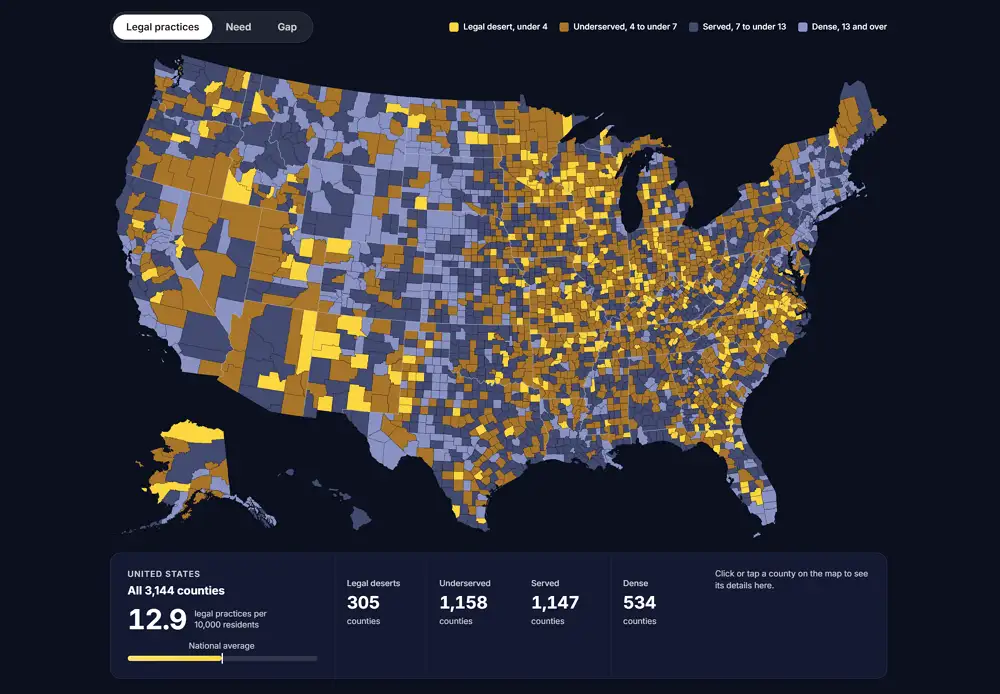
More than 71 million Americans live in counties with few legal practices
The 9.7 million people living in the strictest legal desert category are only part of the story. Another 61.7 million live in underserved counties. Combine the two and you have 71.4 million people, or 20.9% of the population, in counties with fewer than 7 legal practices per 10,000 residents.
Those 1,463 counties account for 46.5% of all counties and county equivalents in the dataset. Almost half the map falls below that threshold, even though those places contain about a fifth of the population.
I do a lot of research into search behavior within the legal market, on both the legal consumer and lawyer/law student sides, and I can tell you that one of the most common questions typed by the latter group is some version of “Is the legal market oversaturated?” This seems almost funny given the legal deserts data, though I can imagine this is because of the crowded nature of the spotlight legal markets across the country and how it affects perception of the market as a whole. It’s easy to think the practice of law is an extremely competitive endeavor when looking at places like New York or Boston.
For law firms looking to expand, I’d, however, be careful about treating the total population as a pool of available clients. The dataset doesn’t show how often residents use out-of-county legal counsel, so firms should account for the possibility that some residents of a legal desert are already served by those providers.
Minnesota shows how a state can have plenty of lawyers and still have gaps in local legal services
Minnesota has 44.7 resident active attorneys per 10,000 people statewide. Yet 50.4% of its residents live in counties with fewer than 7 legal practices per 10,000. In Wisconsin, that population share reaches 57.4%. In North Dakota, it’s a staggering 60.5%.
Attorney totals and practice counts measure different things. A large office can contain many lawyers, but that doesn’t necessarily mean that a licensed attorney is available to take the matter a local resident needs help with. That’s precisely why I wouldn’t use a statewide figure to decide that a county-level market is already well served.
Texas adds another dimension. Its resident active attorney count rose 7.6% between 2020 and 2025, reaching 99,867. Still, 103 Texas counties, containing 3.76 million residents, fall below Pioneerly’s 7-practice threshold or have no licensed attorney. The increase doesn’t tell us where those additional attorneys work. A growing legal profession can coexist with substantial gaps in where practices are located.
North Dakota has the highest share of residents in underserved counties, but North Carolina has the most people affected
Rank the states by the share of residents in legal desert or underserved counties and North Dakota comes first. That represents about 484,000 people. Rank them by the number of residents in those counties and North Carolina leads with 5.24 million, followed by California with 4.50 million.
That distinction matters when we talk about firm expansion. A high percentage tells us how widespread low practice density is within a state. A large population tells us how many people live in those counties. I want both views before deciding where to investigate for expansion opportunities.
California illustrates my point best. Its share of residents in legal desert or underserved counties is 11.4%, well below the national figure of 20.9%. But that still represents 4.5 million people. Looking only at the percentage could lead a firm to overlook local markets worth considering for expansion.
Small resort counties can have more legal businesses per resident than Manhattan
Teton County, Wyoming, has 64.3 legal practices per 10,000 residents. Pitkin County, Colorado, has 51.7. Manhattan has 44.6. At first glance, that looks surprising. But the comparison becomes more revealing when we look at the businesses behind those numbers.

Pioneerly’s data counts each law office once, regardless of its size. Manhattan’s employer law offices average about 19 paid employees each, compared with roughly two in Teton and Pitkin. Measured by paid law-office employees per resident, Manhattan is far ahead. A higher number of businesses doesn’t necessarily mean a larger legal workforce.
The resident population also tells only part of the story. A 2024 housing study found that 61% of Pitkin County’s free-market residential units were owned by nonlocal owners. Aspen firms describe serving second-home owners and handling property, estate-planning, and business matters. In Jackson Hole, Teton Trust Company works with high-net-worth clients and advisers worldwide, illustrating how the local wealth-management market extends beyond Wyoming.
That context changes how I read the figures. It suggests these counties support legal businesses serving people and assets that aren’t fully reflected in their resident populations. Before judging a market by its practice count, I’d want to understand the size of those practices, the work they handle, and where their clients actually come from.
The biggest legal need gaps in the U.S. come with an affordability question
Among counties with at least 20,000 residents, Grady County, Georgia, and Union Parish, Louisiana, have the highest gap scores in Pioneerly’s research, at +97.4 and +97.3. The score compares a county’s percentile ranking for legal need with its ranking for legal practices per resident.
Build a better case acquisition system for your law firm.
Tell us about your firm and your goals. We’ll give you our honest take on how to get there.
Grady’s poverty rate is 20.3%. Union Parish’s is 29.4%. Poverty is one of the indicators in Pioneerly’s need index, so that relationship is partly built into the score. I wouldn’t interpret a high ranking as proof of an untapped commercial market.
The question I’d ask is how a firm could make its services accessible to the people who live there. That means understanding the matters residents need help with, what they can afford, and when a referral to legal aid or another provider would be appropriate. Advertising an existing service in a new county won’t, by itself, make that service a good fit for the community.
The best market for law firm expansion depends on your practice area
Adams County, Wisconsin, has at most 1.8 legal practices per 10,000 residents, and 32.21% of its population is 65 or older. For an estate planning, probate, or elder law firm, that makes it a market worth investigating. I’d look at how residents currently find legal help and which local organizations could become referral partners.
In Merced County, California, 25.59% of residents were born outside the U.S., while there are just 3.6 legal practices per 10,000 residents. For an immigration firm, I’d investigate the services available locally, the languages residents speak, and the community networks they trust. Those details would help shape both the firm’s services and how it reaches prospective clients.
St. Mary’s County, Maryland, illustrates why sorting by a single score can cause firms to miss potential markets. It qualifies as a legal desert at 3.0 practices per 10,000 residents, but its need index is 28.5 and its gap score is only +1.1. It would barely register on a shortlist built around the highest gap scores. I’d assess how well a county fits the firm’s practice areas before deciding whether it deserves a closer look.
Nearly 3 million Americans live in counties with only a handful of legal practices
Across 530 counties, about 2.9 million people live with fewer than 3 law offices with paid staff and fewer than 3 solo legal practices based locally. For residents, the choice of a nearby practice is limited before they even consider whether it handles the matter they need help with.
The shortage is more pronounced in some places. Among the 12 states covered by Pioneerly’s county-level attorney records, 22 counties have no licensed attorneys recorded: 12 in Nebraska, 9 in Texas, and 1 in Mississippi.
For a firm considering expansion, I’d start by understanding where residents currently turn for help. Which firms serve them from neighboring counties? How far do they travel for consultations? Who do local businesses and community organizations recommend?
Those answers should shape the firm’s presence. Depending on the community, that could mean a local office, scheduled in-person consultations, or remote appointments supported by local referral relationships. A credible expansion plan should make it easier for residents to find the firm, speak to an attorney, and get help with the matters it’s equipped to handle.
Legal deserts deserve a place in your law firm’s expansion plans
Pioneerly’s research shows that underserved legal markets include growing counties, communities with hundreds of thousands of residents, and places easily overlooked in statewide rankings. For firms considering expansion, there’s good reason to look beyond the familiar cities and examine where their services could make a difference.
I’d start with the cases and matters your team handles best, then identify counties where those services fit local needs. Understanding the competition, how residents find legal help, and what would make your firm accessible gives you a stronger basis for deciding where to invest.
At Pioneerly, we help firms make those decisions and build a complete case acquisition system to support their expansion. We bring together market research, marketing, intake optimization, and revenue analytics so firms can choose where to grow, attract the right clients, and track the results through to signed matters and revenue.
That’s the opportunity I see in this research: helping firms build sustainable practices in places where people have too few local choices. The map gives us a starting point. The next step is understanding the community well enough to become a firm its residents turn to and recommend.