



I host a lot of consultations with family law attorneys every month, and the picture is clear. Most family law firms are still marketing as if Google works the way it did a decade ago.
The family law market is large and crowded, especially in major metro areas. Clio puts the number at nearly 57,000 family law and divorce lawyers across the US. For firms competing to get in front of prospective clients, Google remains a major battleground.
But Google isn’t the only place people can look for a family law attorney anymore. That search can happen inside an AI conversation, and I don’t think most firms have caught up to what that means yet.
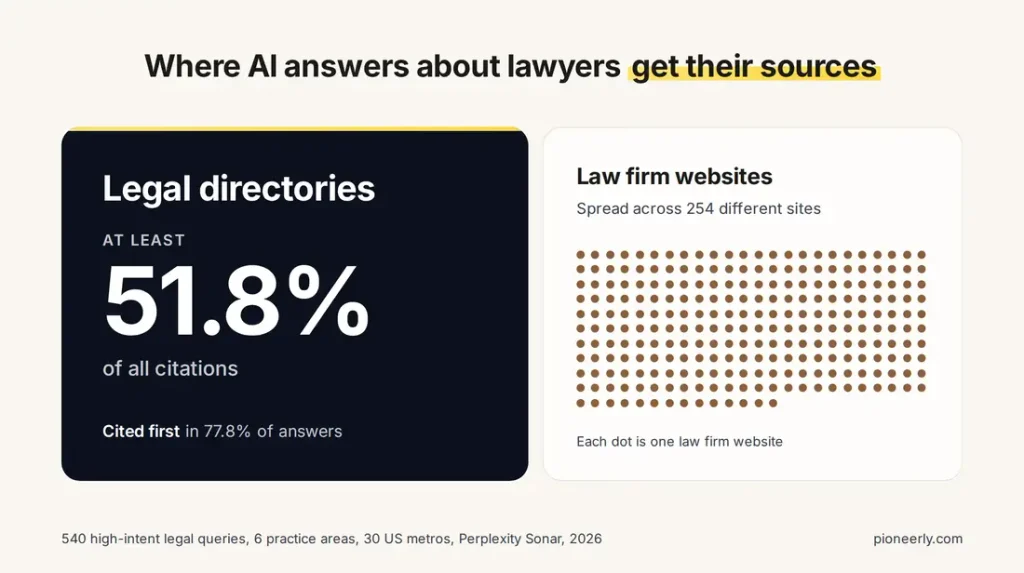
Consider what those conversations actually draw on. A 2026 study tested 540 high-intent legal queries across six practice areas and 30 US metros using Perplexity Sonar. A legal directory was the first source cited in 77.8% of answers with citations, and directories accounted for at least 51.8% of all citations. The law firm citations were spread across 254 different websites. Firms were competing for attention in answers built largely from third-party directories.
Don’t get me wrong. Google isn’t going anywhere. I still tell firms to care about Google rankings. I just won’t tell them that’s enough anymore.
A separate analysis of 102,000 AI responses found that brands ranking number one on Google were mentioned in roughly 33% to 49% of responses, depending on the platform. That study wasn’t specific to law firms, but it illustrates the gap: a top Google ranking doesn’t guarantee a place in an AI answer. Firms need to know whether they’re showing up on the platforms their prospective clients use.
And showing up is only the beginning. Once someone calls or submits an inquiry, your firm still has to respond promptly, follow up, and help that person take the next step. Better visibility can bring people to your door, but what happens next determines whether that attention turns into a client. That’s why I’ll dedicate a substantial part of this article to how your firm handles the inquiries its marketing brings in.
Why Isn’t Ranking on Google Enough for Family Law Firms Anymore?
I think most family law firms are still measuring the wrong finish line.
Google used to be the last checkpoint before a click. Now it’s one of several, and one of them happens before a person ever reaches a website at all.
AI Overviews now trigger on roughly 78% of legal search queries, and they’re taking clicks with them. An Ahrefs study, cited in the same piece, found AI Overviews cut click-through rates to the number one organic result by 58%, nearly double what it was eight months earlier. Between 60% and 69% of searches with an AI Overview now end without a single click to any website.
So a firm can look like it’s winning on a rankings report and still be invisible to the person actually searching. I see this disconnect constantly: a client is proud of a number one ranking and confused about why the phone isn’t ringing the way it used to. This is usually why.
How Is AI Search Changing the Way People Find a Family Law Attorney?
Roughly 1 in 5 consumers say they’d use ChatGPT to find a lawyer. The same report suggests that figure is substantially higher among sophisticated buyers, including general counsel, family offices, and corporate boards. One in five might seem small until you consider what happens after those visitors arrive. The report also points to higher conversion rates among visitors referred by AI tools than among those arriving through organic search.
My read is that some of those visitors arrive with a head start on trust. An AI conversation may have already explained why a firm is worth considering before they ever reach its website. Part of the work of earning their confidence can happen before the click.
That helps explain why I think directories are winning so much of that attention. A bio page that says a firm serves clients with compassion and integrity gives an AI little concrete information to work with. An attorney’s name, bar admissions, specific credentials, and documented case outcomes give it facts it can extract, cross-check, and cite. Directories often organize that information clearly and consistently. Firm websites can do the same, and many have room to improve.
What’s striking is that legal professionals are already embracing AI in their own work. Clio reports that roughly 79% are incorporating AI tools into their daily work. Yet many firms haven’t given the same attention to how prospective clients discover and evaluate them through AI. I think that gap creates an opportunity for firms willing to close it early.
At Pioneerly, we offer SEO and AI search optimization as a single service, helping family law firms improve their visibility across Google and AI answers. If you’d like help with that work, take a look at our SEO and AI search optimization for family law firms.
How Complex Have Family Law Cases Gotten, and Why Does That Matter for Marketing?
Divorce rates overall are falling, but many of the cases firms handle are becoming more complex. I think firms are underestimating how much that shift matters to their marketing.
Gray divorce, or divorce later in life, is a growing share of the work I see firms taking on. These cases often involve retirement accounts and complicated asset division. A generic “we handle divorce” page doesn’t speak to someone trying to untangle a pension after 30 years of marriage. A page that addresses those specific concerns does, and building one is a practical step firms can take now.
That overlap in client needs also helps explain why I’m seeing more family law firms expand into estate planning, probate, and elder law. If the marketing still reads like the firm only handles divorce, prospective clients may never realize what else it can help them with. The firm is underselling its services and missing opportunities to help the same clients with other legal needs.
Build a better case acquisition system for your law firm.
Tell us about your firm and your goals. We’ll give you our honest take on how to get there.
What Family Law Marketing Actually Works in 2026?
Here’s where I focus my work with family law firms to help them attract the right clients and turn more inquiries into signed matters.
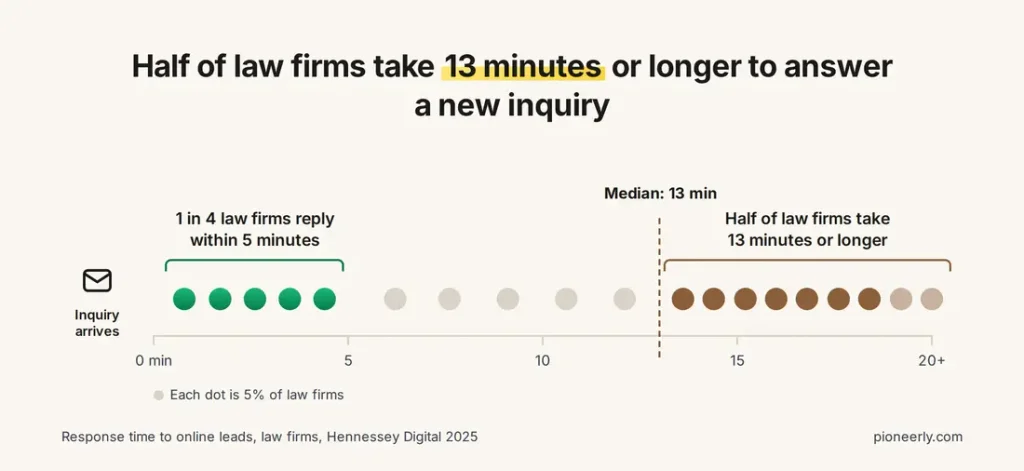
Respond while they’re still looking. Hennessey Digital’s 2025 study found that 25% of firms responded to online leads in under five minutes, while the median response time was 13 minutes. Those extra minutes give someone time to contact another firm and start a conversation you haven’t joined yet.
Make it easy to become a client. Clio’s research found that firms using tools such as online schedulers and intake forms had 51% more leads and 52% more revenue. Those figures don’t mean software alone creates growth, but they reinforce the value of making that first step easier. If a firm’s intake process is losing people, I’d put money into fixing it before buying more ads.
Build content around questions clients actually ask. A useful guide to how divorce works in a specific state can answer several related questions and appear in searches for each of them. The value comes from helping someone understand their situation and what to do next. Hitting a word count does neither.
Be clear about pricing. Clio’s Legal Trends research found that 71% of clients would prefer to pay a flat fee for their entire case. Even when a flat fee isn’t appropriate, explaining how billing works and what affects the cost can make the first call feel less intimidating. In my experience, firms underestimate how often fear of an open-ended bill keeps someone from reaching out.
Give people a reason to trust you before they call. BrightLocal’s consumer research found that 97% of consumers read reviews for local businesses. In family law, prospective clients are trusting someone with deeply personal decisions. Reviews that describe how an attorney communicates, follows through, and treats clients can help them picture what working with that firm would feel like.
Know what your marketing spend produces. WordStream’s 2025 benchmarks placed legal services among the most expensive paid-search categories, with an average cost per lead well above the overall average. At those prices, firms need to know which campaigns bring qualified inquiries and which of those inquiries become clients. Without that connection, the budget becomes an expensive guess repeated every month.
Make it clear who your firm is right for. Someone comparing several firms needs a reason to choose yours. If your website sounds like the next three search results, you’re leaving them to decide on availability, price, or whoever responds first. Explain the situations you handle, the clients you serve, and what they can expect from you. Give them enough substance to recognize a good fit.
How Should a Family Law Firm Think About Marketing Budget?
My rough rule of thumb matches most of the benchmarks I’ve seen: somewhere between 5% and 10% of gross revenue. Under 2%, and a firm is usually just maintaining, not growing.
The number I care about more is cost per signed case, not cost per lead. I’ve seen firms proudly report a low cost per click that’s quietly buying worse-fit clients, and a higher cost per click that’s buying exactly the cases the firm wants. Only one of those is a good number.
Why Do Family Law Firms Lose Clients They’ve Already Paid to Reach?
Personally, this is where I often see the clearest opportunity to help a firm improve, because the fixes are usually straightforward.
Too many prospective clients still struggle to get a timely response. Phone inquiries go unanswered, web forms sit in inboxes, and some people never hear back at all. Even when someone calls during business hours, reaching a real person on the first try isn’t a given.
In family law, that gap can be especially costly. Someone may finally work up the nerve to call about a divorce or custody issue in the evening, over a weekend, or during a holiday. Their need for help doesn’t follow the firm’s office hours.
When that person is left waiting, the silence can feel personal. They may already be worried about whether anyone will listen or take their situation seriously. A prompt, thoughtful response gives them a reason to feel reassured and take the next step.
Slow responses cost firms clients and revenue. Yet those losses often appear on a marketing report simply as leads that didn’t convert. I’ve watched firms respond by spending more on ads when the real issue was what happened after the inquiry arrived.
That’s why I focus on intake before recommending more ad spend. I’d rather spend a week helping a firm answer calls faster and follow up consistently than a month optimizing ad copy while prospective clients are still waiting to hear back.
Does Advertising Compliance Matter for Family Law Marketing?
Yes, and I treat it as part of building the campaign from the start. Family law marketing reaches people dealing with custody concerns, relationship breakdowns, and financial uncertainty. The message needs to be persuasive without promising an outcome or adding to someone’s fear.
The details depend on the state where the firm practices and the type of advertising involved. Required disclosures, statements about qualifications, and rules for contacting prospective clients aren’t identical nationwide. For example, Florida requires lawyer advertisements to identify the lawyer or firm and include a bona fide office location. A platform’s “Sponsored” label doesn’t cover those requirements.
The claims themselves deserve just as much attention. “We’ll help you understand your custody options” communicates a service. “We’ll get you full custody” promises a result the firm can’t control. Even a truthful account of a past success can create misleading expectations if the context is missing, a concern addressed in the ABA’s commentary on Model Rule 7.1.
Client stories need particular care, too. A compelling testimonial or case summary may reveal sensitive information about a marriage, a child, or a family’s finances. Before using one, the firm should review consent and confidentiality obligations under its applicable rules. The ABA’s Model Rule 1.6 provides the general framework for protecting information relating to a representation.
In practice, I want the ad copy, images, targeting, and landing page reviewed together, with the firm’s responsible attorney checking the applicable requirements before launch. Any required disclosures, filing, or review steps belong in that process.
I don’t see compliance as a reason to avoid paid social. It’s part of building a campaign the firm can confidently stand behind. Clear claims, accurate credentials, and respectful messaging also give prospective clients a better reason to trust what they’re reading.
Family Law Marketing in 2027: How to Prepare Your Firm
Preparing your family law marketing for 2027 starts with how prospective clients find and evaluate your firm today. Google still matters, but AI tools are creating another place where people compare attorneys and decide whom to call. Your marketing needs to help them find you and feel confident taking that next step.
That confidence comes from specifics: content that speaks to their situation, clear information about your experience and fees, and a thoughtful response when they reach out. Someone facing a divorce or custody dispute needs to know you understand what’s at stake and can help them move forward.
That’s where I focus my work with family law firms: connecting visibility to intake, tracking marketing spend through to signed matters, and making sure the firm’s message reflects the work it wants to attract and is equipped to handle.
Before committing your 2027 marketing budget, look at the whole path. Can the right clients find you on Google and in AI answers? Can they see why you’re a good fit? Can they reach someone who follows through? Do you know which efforts are bringing in the right matters?
Use those answers to decide what to strengthen now. A firm that enters 2027 with clear positioning, responsive intake, and a solid understanding of what brings in clients will have a stronger foundation for every campaign it runs.